Wedding witnesses in Belgium: how many, who to choose, and their actual role

Article summary
In Belgium, wedding witnesses have not been mandatory since 2010, but their role remains central. How many to have, who to choose, and what they really do before, during, and after the big day.
Summarise with AI
Type "wedding witnesses Belgium" into a search engine and you'll find the same recycled advice from one French blog to another: you need two witnesses, choose your best friend, prepare a speech. Except that much of this certainty doesn't hold true once you cross the border.
The legal reality in Belgium is simpler, and above all more flexible. Since 2010, the civil wedding does not require any mandatory witnesses. You can get married just the two of you, alone in front of the registrar. Or surrounded by four people who will sign the register. It's your choice, not a box to tick.
The real question remains, one that the Civil Code doesn't settle: who to choose, what for, without this choice turning into a family crisis. We'll go through everything, from the Belgian legal framework to the actual role of a witness.
Since 1st July 2010, the presence of witnesses at a civil wedding in Belgium is optional. A maximum of four for the couple, all adults. The rest is not played out at the local council, but in the meaning you give to this role.
Wedding witnesses Belgium: what the law really says

Forget what you've seen in American films. In Belgium, the rule has changed completely since 1st July 2010: a civil wedding can be celebrated without any witnesses. If you decide to have them, the law sets only one limit: a maximum of four for the couple.
The conditions are straightforward. A witness must be of legal age and legally capable: 18 years old, and not under administration. That's it. No family relationship required, no nationality imposed. Your neighbour, your brother, or your office colleague will do just as well.
Regarding paperwork, a detail often overlooked: during the declaration of marriage, between six months and fifteen days before the date, the registrar requests a double-sided copy of each witness's identity card. Obtain it in advance. For the rest of the file, see our guide on the documents required for a civil wedding.
Civil witnesses, Belgian version
Civil witness or witness of honour: two roles often confused
 MYSA EVENTS
Here's the nuance that no one explains. There are two distinct "witnesses". The first is administrative: they sign the register at the local council, under the authority of the registrar. Their role lasts three minutes and ends with a stroke of a pen.
The second is the celebration witness, the one who truly matters to many couples. They have no legal existence, but carry all the emotional weight: they support you before, accompany you during, and sometimes speak. Nothing requires them to be the same person as the signatory.
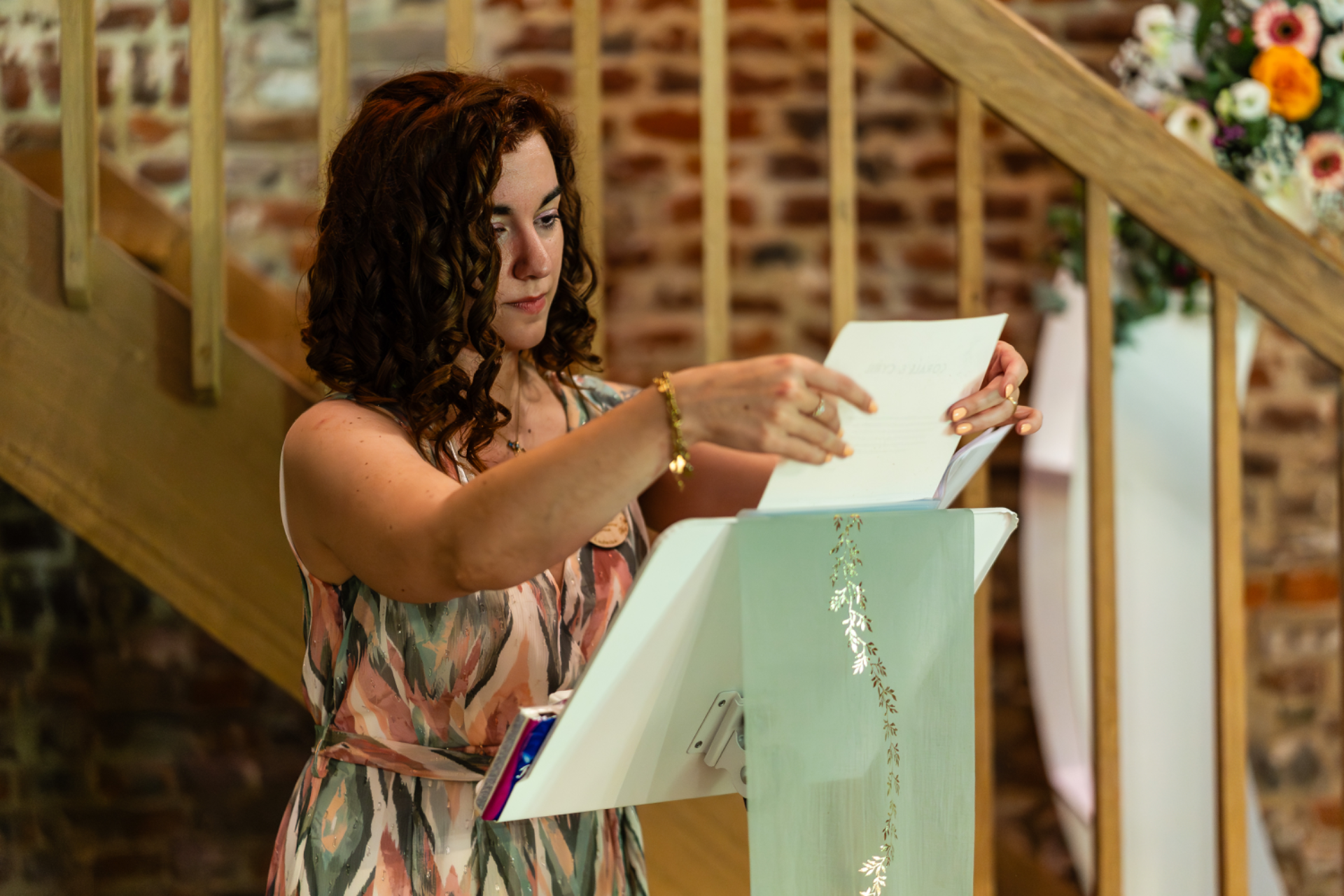
It is in a humanist ceremony that this second role takes on its full significance. Belgian officiants, such as Ludwina from Mysa Events, often have a witness speak, as part of a ritual or reading: they become an actor in the story, not just a background extra. The supplier directory is full of officiants who will build this moment with you.
Zero, two or four: how many to choose

The classic setup is two witnesses, one for each person getting married. Simple, balanced, clear. But nothing makes this mandatory. Some sign alone, for a surprisingly intimate civil wedding. Others opt for four, often to include a large sibling group or a blended family.
Frankly, four witnesses just to avoid upsetting anyone is rarely a good idea. The more names there are, the more the role becomes diluted and loses its meaning. It's better to have two truly committed people than four honorary presences wondering what they're doing there. The number doesn't impress anyone. The involvement does.
Choosing your witnesses without falling out with family

The number one pitfall is choosing out of obligation. The eldest brother because he's the eldest, the cousin because she picked you last year, the childhood friend you now only see at funerals. These 'logical' choices often lead to disappointment when you need real help.
Ask yourself three concrete questions. Is this person reliable when it matters, not just nice over a beer? Will they be available in the months leading up to the wedding, not just on the day itself? And most importantly: can they say no to you when you're obsessing over a small decor detail? A good witness is also a safeguard.
And if a relative is upset, there are a thousand other ways to involve them: a reading, a role in the ceremony, managing a specific moment. Not everyone needs to sign the register to feel like they belong.
The real role of a witness: before, during, after
 RAW16 PHOTOGRAPHY
Before the big day, a witness is primarily a support. They listen to you complain about the caterer, help you decide between two venues, manage the logistics of the stag party or the hen party. This is the longest, least visible, and most precious role.
On the day itself, they change hats. Signing the register if they are a civil witness, but most importantly, discreet coordination: greeting lost guests, notifying the DJ that the cake is coming, finding wedding rings misplaced in a suit pocket. Sharing your big day schedule with them beforehand, hour by hour, saves them from chasing information.
Afterwards, they are often the last ones standing: collecting gifts, bringing back equipment, wrapping up with suppliers while you go off to relax. A thankless role that good witnesses take on without being asked.
The witness speech: dare, or pass

No, the speech is not mandatory. Belgian weddings are often less focused on a series of speeches than their Anglo-Saxon counterparts, and that's a good thing. If your witness hates public speaking, no one will blame them for abstaining. Forcing them will only guarantee an awkward moment.
For those who do give one, the recipe is simple: short, a true anecdote, zero private jokes that half the room won't understand. Three minutes are enough. A good speech is one after which the married couple's eyes sparkle.
Tricky cases: blended families, long-distance witnesses
 LE DOMAINE DE L'ART DE VIVRE
Blended families require tact. Choosing one half-sibling and not the other can stir up the same tensions as during the seating plan. The most honest approach: decide as a couple, inform those concerned before they find out on the big day, and own your decision.
The witness who lives abroad is the other headache. Signing the register requires a physical presence at the local council: no power of attorney. If your best friend lives in Montreal with no certainty of attending, plan a backup for the administrative side, even if it means giving them a strong symbolic role.
As for the childhood friend you've lost touch with, to whom you swore this role at fifteen: free yourself from that pact. A witness should reflect your present, not a teenage promise.
Your witnesses, your organisation, your big day all in one place
Turn your organisation into an interactive checklist, centralise your guests, and build your big day schedule to share with your witnesses. In your WeWED couple space.
Create my couple space →So, will it be one witness, four, or just the two of you in front of the officiant? Tell us about your choice. 👇
Frequently asked questions about wedding witnesses in Belgium
Are witnesses mandatory for a civil wedding in Belgium?
No. Since 1 July 2010, the presence of witnesses at a civil wedding is optional. You can get married without any witnesses, or appoint up to four for the couple.
How many witnesses can you have at most?
A maximum of four for both the bride and groom combined. Many couples choose two, one for each, but the law imposes neither a minimum nor a distribution.
Who can be a wedding witness?
Any person who is of legal age and legally capable, meaning at least 18 years old and not under guardianship. No family relationship is required, and Belgian nationality is not necessary.
Does a witness need to provide documents to the local council?
Yes. When declaring the marriage, you must submit a double-sided copy of the identity card for each witness. Plan this in advance to avoid delaying the application.
Can you have a witness at a humanist ceremony without them signing the register?
Absolutely. The witness for a humanist ceremony or a party has no legal role. You can therefore assign the symbolic part to one person and the civil signing to another.
Can a witness living abroad still sign?
Only if they are physically present at the local council on the day of the ceremony: signing the register does not allow for a power of attorney. Arrange for a replacement for the deed if they might be absent.
This guide on wedding witnesses in Belgium is based on official sources: the information sheet "Marriage: optional presence of witnesses" from notaire.be (Fednot) and the "Marriage declaration" page from the City of Nivelles. Practical arrangements (Saturday fee, documents to provide) may vary from one local council to another: always check with your civil registry office.