Humanist Wedding Ceremony in Belgium: How to Organise a Truly Personalised Ceremony

Article summary
The complete guide to humanist ceremonies in Belgium: legal standing, effective structure, choosing an officiant, rituals, 2026 budget, and the 5 mistakes to avoid.
Summarise with AI
Since 2022, the humanist ceremony has become the dominant format in Belgium. More couples today choose a humanist celebrant than a priest or pastor, and figures confirm a continuous increase in union ceremonies across the country. This is the logical response to a society where religious practice is declining, but where couples still seek a solemn moment that truly tells their story.
However, humanist does not mean easy. A successful ceremony requires a narrative thread, well-executed rituals, and a celebrant who can manage the emotion of a group for 45 minutes. Poorly done, it means 35 people crying with boredom on folding chairs while a cousin reads a text found on Pinterest. This guide is designed for Belgian couples: legal framework, ingredients that work, mistakes to avoid, real cost, and the type of celebrant to choose according to your project.
This article assumes you have already been (or will be) through the civil wedding at the local council. The humanist ceremony never replaces it. If you haven't started the process yet, begin with our guide on the documents to provide to the local council.
The humanist ceremony has no legal value: what that implies

First point to understand: the humanist ceremony has no legal implications. In Belgium, only the civil wedding, celebrated at the local council before the civil registrar, produces legal effects. This principle dates back to the 1831 Constitution, which requires the civil wedding before any religious ceremony. The humanist ceremony remains a symbolic union ceremony, with no official register, no signature that counts in the eyes of the law.
You can sign a register with your witnesses on the big day, but it is not recognised by any Belgian administration. It is a couple's item, to keep at home. The Centre d’Action Laïque is clear: the humanist ceremony is a celebration of personal commitment, not a civil act.
This framework changes two things. You are completely free regarding the content (no imposed rituals, no mandatory texts, no dictated venue), but also responsible for constructing the whole. No one will give you a pre-formatted schedule, unlike religious ceremonies.
Why this format is gaining popularity in Belgium

StatBel figures for 2024 show the extent of the shift: 48,589 weddings celebrated in Belgium, the highest level since the beginning of the century. At the same time, Catholic religious weddings have fallen to 4,896, a 6.5% decrease year-on-year. This growth does not benefit the Church. It benefits civil weddings alone, extended by a humanist ceremony.
On the ground, almost all Belgian celebrants and wedding planners observe the same thing: the demand for personalised ceremonies has doubled in five years, driven by urban couples in their thirties and mixed couples (French-Belgian, Belgian-Italian, binational Flanders-Brussels) who are looking for a ceremony that speaks to everyone.
Honestly, I think it's healthy. A wedding without a proper ceremony means two minutes at the local council and then the reception. For couples who want a real moment where things are truly acknowledged, the humanist ceremony fills a void that nothing else occupies today.
Choosing a celebrant: the 4 profiles that exist
 MYSA EVENTS
Four options exist in Belgium. Choosing the wrong profile is the recipe for a ceremony that feels inauthentic.
A close relation (friend, sibling, parent)
- Budget: zero euros, a symbolic gift.
- For whom: couples who have a close relation comfortable with public speaking and willing to spend 20 to 30 hours preparing.
- The risk: 80% of the time, the close relation underestimates the work and arrives on the day with a text written three days before. It shows.
The humanist advisor (Maison de la Laïcité)
- Budget: free or voluntary contribution.
- For whom: couples attached to the institutional humanist tradition, especially in Brussels and Wallonia.
- Limitation: a more sober framework, less personalisation than with an independent celebrant. Slots fill up quickly during peak season.
The independent professional celebrant
- Budget: €800 to €3,500 depending on experience.
- For whom: couples who want real support, bespoke writing, and carefully staged presentation.
- What you pay for: two to four appointments, writing, sound system, sometimes coordination of speakers.
The wedding planner who also officiates
- Budget: included in a coordination + ceremony package.
- The downside: one person can hardly coordinate the day and lead the ceremony with the energy it requires. Clearly ask who does what on the big day.
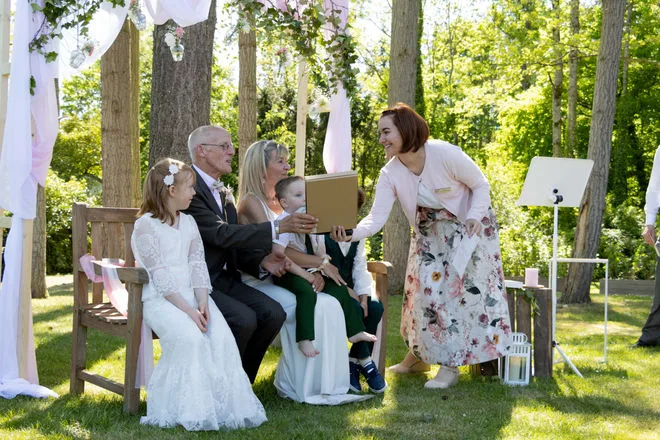
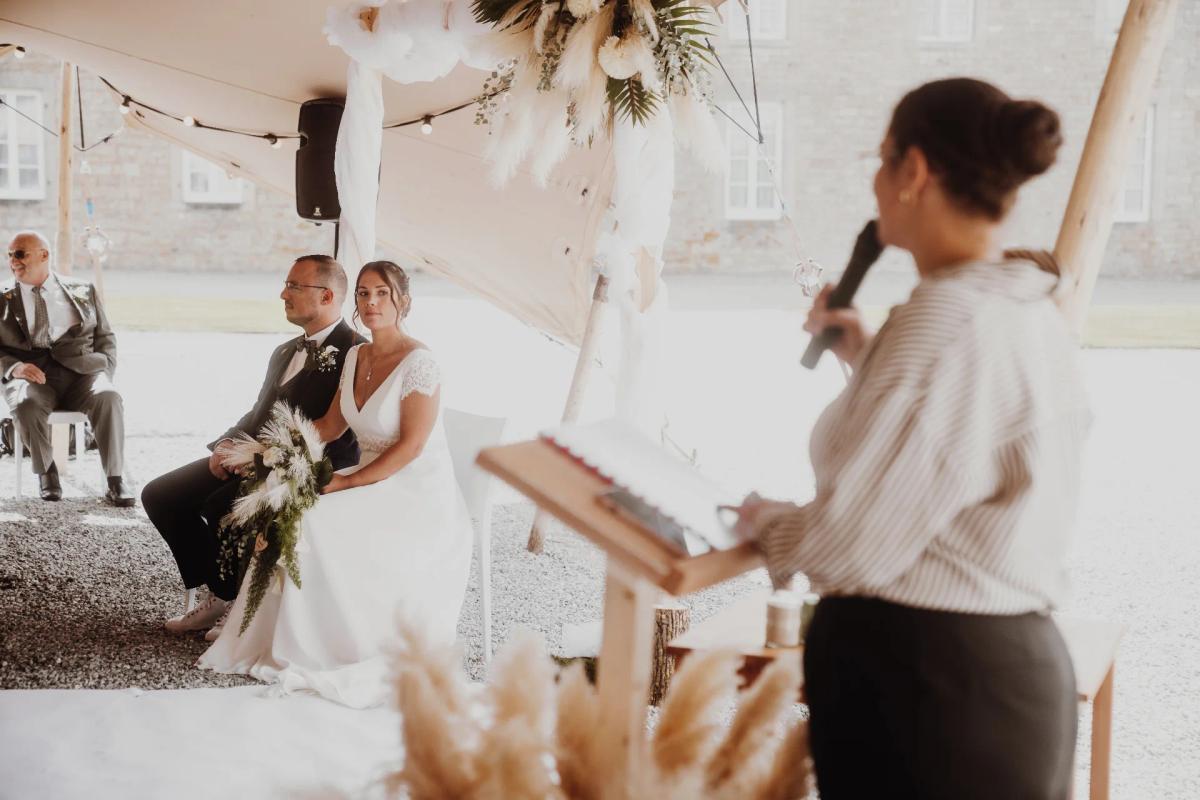
Independent celebrants like Ludwina from Mysa Events (based in La Louvière, active throughout the country in French and Spanish) or Stéphanie from Vert le Bonheur (based in Profondeville, covering Brussels, Namur, Walloon Brabant, Liege, Hainaut and Luxembourg, and who adds to bespoke writing a committed focus on reducing the environmental impact of the wedding) illustrate this profile 3 well: support over several sessions, personalised rituals, warm tone. Contact 8 to 10 months before the date to secure your slot.
 VERT LE BONHEUR
Building the Flow: Ingredients That Work
A successful ceremony lasts 35 to 50 minutes. Any shorter, it feels unfinished. Any longer, guests lose interest. Within this timeframe, you'll almost always find the same blocks.
The Skeleton of a 45-Minute Ceremony
This skeleton isn't an absolute truth, but it's a solid framework. The block to watch is the speeches from loved ones. Beyond four speakers, the ceremony loses its intensity and guests start looking at their watches. Frankly, two well-crafted speeches are better than six average ones.
For the script, a useful preparatory exercise: together, write a 500-word document telling the story of how you met and what the other person means to you. Give it to the officiant as raw material. This prevents them from starting from scratch and ensures the ceremony feels authentic.
Symbolic Rituals That Work
 MYSA EVENTS
The symbolic ritual is where many ceremonies go awry. Some are visually poor (no one can see anything from row 5), others are so clichéd they break the emotion.
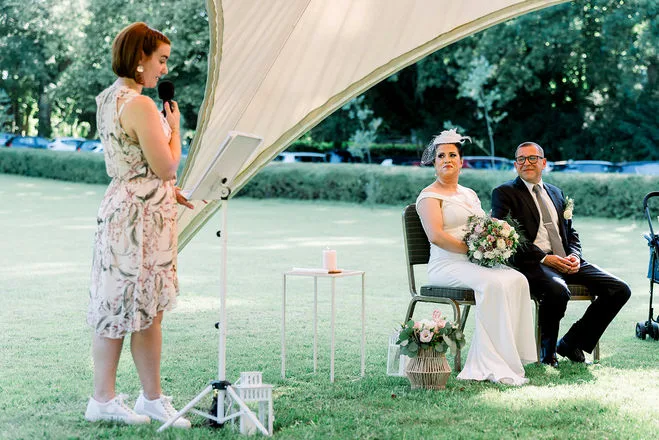
What works well. The ribbon ritual (each loved one ties a coloured ribbon symbolising a value), the hand ritual (the officiant takes the couple's hands and says a text about what they will do together), the wine or beer ritual (sealed in a box with vows, to be opened on the 5th anniversary), personal vows written separately and read face to face.
What to avoid. Coloured sand poured into a vase (pretty up close, invisible from afar), planting a tree in the middle of the ceremony (too much logistics, breaks the rhythm), and rituals imported as-is from a tradition not shared. Always ask yourself: does this tell something about us, or are we doing it because we saw it on Pinterest?
One well-chosen ritual is better than three piled up. The ceremony gains clarity, guests follow along, and the key moment remains impactful.
The Venue: Belgian Practical Constraints
 VERT LE BONHEUR
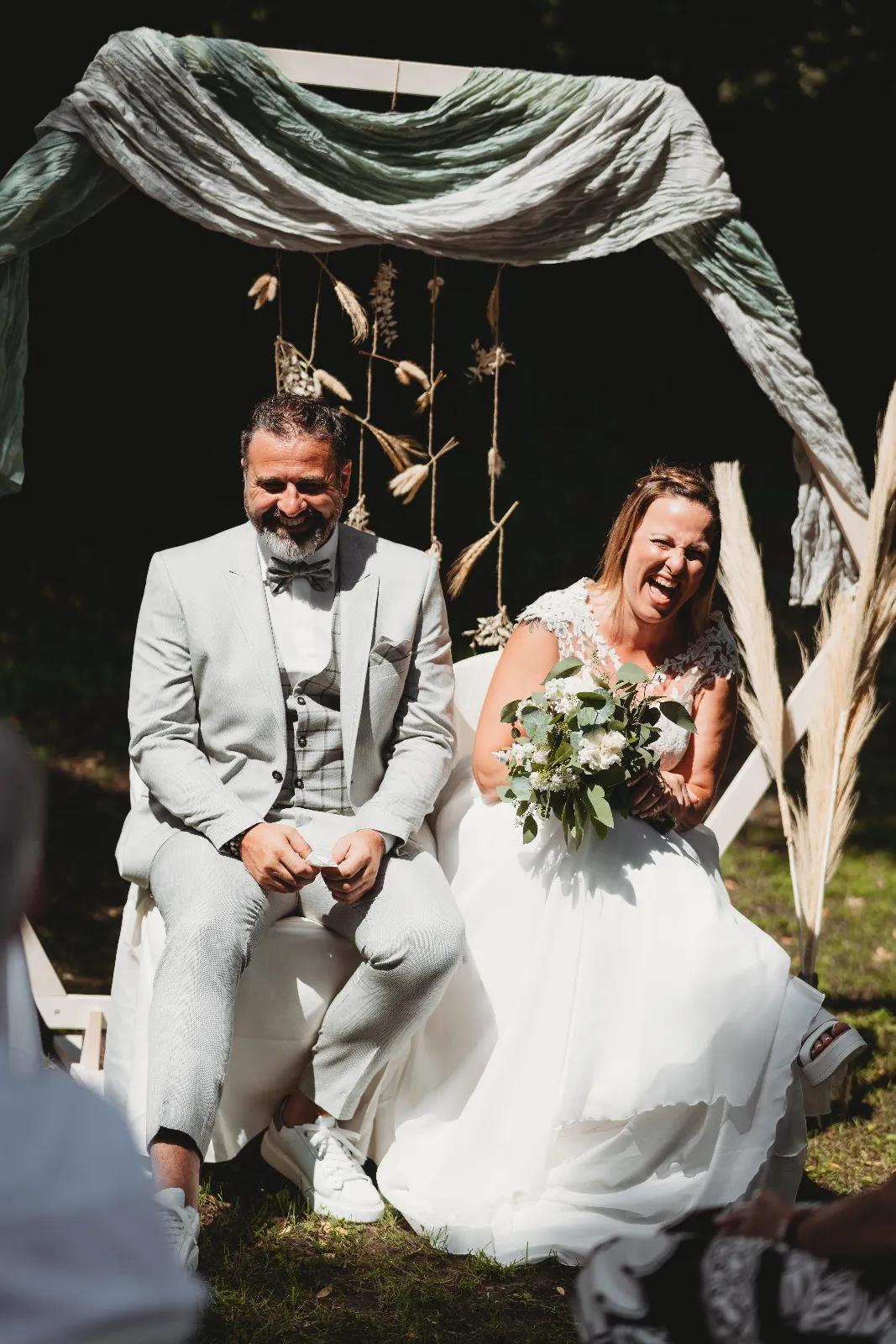
The venue is flexible in Belgium: private garden, château, barn, forest, hall, estate. The Centre d’Action Laïque only specifies that it must be a neutral place outside the local council office. The real constraint is not legal, it's weather and logistics.
Three points to confirm with the venue before signing:
- Covered backup plan: desacralised chapel, orangery, reception venue, converted barn. Between May and September, it rains 12 to 15 days a month on average in Belgium. This is not a luxury.
- Sound system: if the officiant doesn't bring their own, check what the venue provides. Without a proper wireless microphone and speaker, guests at the back won't hear anything.
- Acoustics: an area that's too large or too windy swallows speech. Opt for inner courtyards, sheltered clearings, marquees closed on three sides.
For Walloon estates, see our guide on the most beautiful châteaux for a wedding in Wallonia. Most venues in the WEWED directory already offer a dedicated ceremony area, with an arch and integrated backup plan.
The six recurring mistakes we see
- Announcing the time vaguely. 4:00 PM on the wedding invitation = 4:25 PM actual start. Indicate a welcome time 30 minutes before the actual start time.
- Too many interventions from loved ones. Six speeches = disengagement. Two to four are enough, 3 minutes max per speech.
- No rehearsal. A run-through 48 hours beforehand avoids 90% of glitches: sound system, placement, entrance, child management.
- Forgetting the children. Ten children with no one dedicated to the back, and they become the soundtrack to your vows.
- A main ritual that's too long. Beyond 6 minutes, it becomes a skit. Cut it short.
- Photographer not briefed. They must know the timing and key moments before arriving, otherwise they'll miss the exchange of vows while changing lenses.
What it really costs

The observed price ranges for Belgian officiants in 2025-2026 are around €800 to €3,500 for the service alone, depending on customisation and preparation time. To this, you need to add furniture (arch, chairs for 80 to 120 people), sound system if not included, and possibly an acoustic duo.
Humanist ceremony budget for 80 guests
This budget is in addition to the rest. The ceremony rarely accounts for more than 6 to 8% of the overall budget, a cost item where costs are rarely cut: it sets the tone for the entire beginning of the day. See our guide on the wedding budget in Belgium 2025-2026 for a complete breakdown.
Centralise your wedding day planning with all your suppliers
The ceremony involves the officiant, the photographer, the DJ, and the venue. If the timing is poorly communicated, the reception can start an hour late. The WEWED wedding day planner allows you to build a timeline hour by hour, then share it with each supplier.
Create my planner →Organising a humanist ceremony means embracing complete freedom: no imposed framework, no official register, no mandatory text. This freedom requires writing, rehearsing, and selecting. When done well, it is often the moment guests are still talking about six months later. To stay on track, see our month-by-month wedding planning timeline and centralise your appointments in your WEWED couple's area.
Have you ever attended a humanist ceremony that really stood out to you (or the opposite)? Which ritual was successful, and which seemed superfluous? 👇
Frequently Asked Questions about humanist ceremonies in Belgium
Does a humanist ceremony replace a civil wedding in Belgium?
No. Only a civil wedding at the local council has legal value in Belgium. A humanist ceremony is a symbolic celebration with no legal effect. It can take place before or after the civil wedding, but never in its place.
How long before the wedding should an officiant be booked?
Ideally 8 to 12 months before the date, especially for a wedding from May to September. The most sought-after officiants in Belgium close their diaries a year in advance. Outside peak season, 4 to 6 months may suffice.
What is the average price of a humanist ceremony in Belgium?
The officiant's service alone costs between €800 and €3,500 depending on experience and level of customisation. With furniture, sound system and possible live music, the total budget for 80 guests is more around €2,500 to €4,500.
Can a humanist ceremony be organised outdoors in Belgium?
Yes, Belgian law does not impose any mandatory location. You can celebrate in a garden, a castle, a forest, a courtyard. A covered backup plan is essential: between May and September, it rains 12 to 15 days a month on average.
Can you get married in a humanist ceremony if one of the partners is of foreign nationality?
Yes, without restriction, as the ceremony is symbolic. The only condition comes from the civil wedding, which requires specific documents for the non-Belgian spouse (legalised birth certificate, certificate of celibacy, proof of residence). See our guide on civil wedding documents Belgium for details.
Are witnesses required for a humanist ceremony?
Nothing is imposed. Many couples choose 2 to 4 witnesses who sign the symbolic register and sometimes speak during the ceremony. These witnesses do not need to be the same as those for the civil wedding.
This article is based on the following official Belgian sources: 2024 wedding data from StatBel, the legal framework of the SPF on civil wedding formalities, and the definition of union ceremonies by the Centre d’Action Laïque. The price ranges are estimates observed among Belgian suppliers active on WEWED in 2025-2026, notably Mysa Events in La Louvière and Vert le Bonheur in Profondeville. They vary according to region and supplier.


