Legal Cohabitation or Wedding in Belgium: The Real Legal and Fiscal Differences

Article summary
Legal cohabitation or wedding in Belgium: what truly changes for your accommodation, inheritance, taxes, and separation. The clear comparison to help you decide.
Summarise with AI
You live together, everything is going well, and one day the question arises: should we get married, or is a signature at the local council enough? In Belgium, this is not a mere detail of vocabulary. Behind the choice between legal cohabitation or wedding lie very concrete rules regarding your housing, your inheritance, your taxes, and what happens the day one of you passes away or leaves.
The trap is to believe that the two statuses are equivalent because they look similar on paper. They protect your couple to very different degrees. On some points, the law treats them almost identically. On others, the gap is enormous, to the point of leaving the survivor with nothing.
Here, we sort through this, relying on current Belgian rules, without unnecessary jargon. The goal: to give you the information to decide knowingly, not to sell you one status over another.
This article provides general guidelines, not personalised legal advice. Every situation (children from a previous union, property purchase, self-employed, family assets) changes the game. For a binding choice, an appointment with a notary remains the only real safety net.
Three statuses, not two
When you are in a couple in Belgium, the law recognises three situations, not two. Marriage. Legal cohabitation. And de facto cohabitation, that of most couples who move in together without signing anything.
De facto cohabitation is the zero degree of protection. You share a roof, bills, sometimes a loan, but in the eyes of the law, you remain two separate individuals. If one passes away, the other has no right to their inheritance, except through a will.
Legal cohabitation is in the middle: a hybrid status, lighter than marriage, which takes you from "romantic flatmates" to a recognised couple, with some minimal protections. Marriage remains the most complete of the three. It remains to be seen how much protection you need.

Commitment: a signature or a ceremony
This is the first major difference, and it is telling. Becoming legal cohabitants takes just one visit. Both partners go to the local council of their shared residence and submit a written declaration to the civil registrar. The cost? Variable depending on the local council: some offer it for free (it costs nothing in Ghent, for example), others charge a fee, generally between €20 and €60 (€57.80 in Ganshoren in 2026). No witnesses, no publication, no waiting period.
A wedding is a different calibre: a dossier to compile, a series of documents, a legal period between the declaration and the celebration, then a real ceremony before the civil registrar. We have detailed this paperwork in our guide to the documents required for a civil wedding in Belgium, because that's often where couples lose weeks. The cost of a civil wedding also varies widely from one municipality to another: the ceremony is free on some days in 31 of the 49 municipalities we surveyed, but a Saturday ceremony comes with a fee almost everywhere. You'll find the fees in our survey of civil wedding fees, municipality by municipality.

This administrative simplicity is the main argument for legal cohabitation. But it has a counterpart, which we will see later: what is easily undone also provides less protection.
Your assets: who owns what
Here, the two statuses follow opposing logics. In legal cohabitation, each person remains the owner of what belongs to them: salaries, accounts, car in your name, everything remains yours. The law adds a presumption of undivided ownership for assets where no one can prove ownership (the sofa, the fridge bought together without a named invoice). There is no automatic common patrimony.
A wedding, by default, is the opposite. Without a contract, you fall under the legal community property regime: your income and what you buy during the marriage become common, even if only one of you signed for it. What each of you owned before the marriage, and what each of you receives through inheritance or donation, remains your own. This is powerful for mutual protection, but it can be adjusted beforehand if you want something different. We dissect the three regimes (community, separation of assets, universal community) and their real consequences in our article on the wedding contract in Belgium.
Both statuses protect the family home. Whether you are married or legal cohabitants, one cannot sell or mortgage the shared residence without the other's agreement, even if the property is solely in their name. De facto cohabitants, however, do not have this safeguard.
Succession: The Real Divide Between the Two
If you were to remember only one difference, this is it. This is where "almost the same" becomes "not at all the same".
The surviving legal cohabitant inherits the usufruct of the family home and the furniture it contains. Concretely, they can continue to live in the house. But beware of the detail that changes everything: this right is not reserved. In other words, the deceased partner could, during their lifetime, revoke it by a simple will. The legal cohabitant can therefore find themselves deprived of everything, overnight, without having a say.
The surviving spouse plays in a different league. Without a will, they inherit the usufruct of all the deceased's estate if there are children (not just the home), and more if there are none. And above all, they are a reserved heir. Translation: in principle, they cannot be completely disinherited. The law guarantees them a minimum share: at least the usufruct of half the estate and, in all cases, the usufruct of the family home. The only exceptions: a de facto separation, divorce proceedings under way, or a Valkeniers pact signed before a notary when one of you has a child from a previous union. It is this reserved share that makes the wedding so solid in terms of succession.

What the survivor receives, without a will
Good news for legal cohabitants: this gap can be partially filled with a will or a donation. But that requires an active step. A wedding, on the other hand, provides automatic protection. That's the whole nuance between "protected unless one thought to write the opposite" and "protected unless one organises something else".
Taxation: Where it's Almost the Same
This is the point that surprises most people. In terms of taxation, legal cohabitation largely catches up with a wedding.
For income tax, legal cohabitants are treated like married couples: joint declaration, same mechanisms. De facto cohabitants, on the other hand, declare separately. And for inheritance tax, the surviving legal cohabitant benefits everywhere from the rate reserved for spouses, which is the most advantageous, instead of the discouraging rate applied between unrelated individuals. In Brussels and Flanders, de facto cohabitants are also entitled to it after one year of living together; in Wallonia, they are not.
In Brussels, the surviving spouse or legal cohabitant pays nothing on the first €15,000 of their share, nor on their share of the family home. In Wallonia, the tax-free allowance is €12,500 (€25,000 if their net share does not exceed €125,000), and the exemption for the family home currently requires the couple to have lived there for at least five years. A decree passed at the end of 2024 provides for this condition to be removed for deaths from 2028 onwards, but the Walloon government is considering revising or postponing this reform. Flanders applies its own rules, in the same spirit. In short, in terms of taxation, choosing legal cohabitation instead of a wedding almost never penalises you. The real difference lies elsewhere.

What Only a Wedding Protects
Beyond taxation, some protections remain the exclusive domain of a wedding. These are what tip the scales when the stakes become serious.
Protections that legal cohabitation does not offer
- The reserved portion of the estate: it is impossible to completely disinherit one's spouse, as we've seen.
- The survivor's pension: this generally remains reserved for married people. A surviving legal cohabitant is not entitled to it, even after years of living together.
- The presumption of paternity: a child born during the marriage automatically has the husband as their father or, in a couple of two women, the wife as their co-parent. In cohabitation, whether legal or de facto, formal recognition is still necessary.
- The duty of assistance: spouses owe each other aid and assistance, including financial. Legal cohabitation is limited to contributing to household expenses.
Frankly, it is this list that decides the debate for many couples. As long as there are no children, no major income disparity, and no assets to pass on, legal cohabitation is largely sufficient. As soon as one of these elements comes into play, a wedding regains the advantage. And if you want to add a symbolic dimension without going through a religious ceremony, our guide on a humanist ceremony in Belgium shows how to mark the occasion differently.
Separation: Easy on One Side, Judicial on the Other
The symmetry is perfect with commitment. What is quickly tied is quickly untied.
Ending a legal cohabitation is almost as simple as entering into it. Either both partners go to the local council together, or one does so alone. In this unilateral case, expect a local council fee that varies from one council to another (€25 in the City of Brussels, €57.80 in Ganshoren in 2026), plus the bailiff's service fees, paid in advance (Wuustwezel, for example, quotes a deposit of €250), as the other party must be officially notified. One can therefore leave the status without the partner's agreement. Simple, quick, sometimes a little cold.
Divorce is a completely different story. It involves a judicial procedure, delays, often solicitor's fees, and the division of assets that have become joint. Nothing insurmountable, but nothing expeditious either. This complexity is the flip side of protection: a wedding binds you more strongly, so it is less easily undone.
Whether you choose to sign at the local council or have a full ceremony, many couples still want to gather their loved ones for a celebration. Venues like Le Petit Versailles in Gosselies host both intimate celebrations and large receptions: the chosen legal status does not dictate the scale of the party.
 LE PETIT VERSAILLES
So, legal cohabitation or wedding?
There's no universal answer. But there are some clear guidelines.
Legal cohabitation ticks many boxes for a young couple, without children, with still modest assets, who want legal recognition and tax advantages without the solemnity or irreversibility of a wedding. It's an excellent first step: you keep your financial autonomy, protect your home, pay your taxes like a married couple, and can end it without legal proceedings.
A wedding becomes the rational choice as life gets more complex: a child, a joint property purchase, one partner being self-employed, a significant income disparity, or the desire to guarantee the survivor will never be left out. In my opinion, it's less a question of love and more a question of a safety net. Both statuses say "we are together". Only a wedding adds "and this is what protects you, no matter what".
One final thought, valid in both cases: plan ahead. Open the file early, list the steps, schedule appointments, just like in a month-by-month preparation checklist, alongside your budget and suppliers.
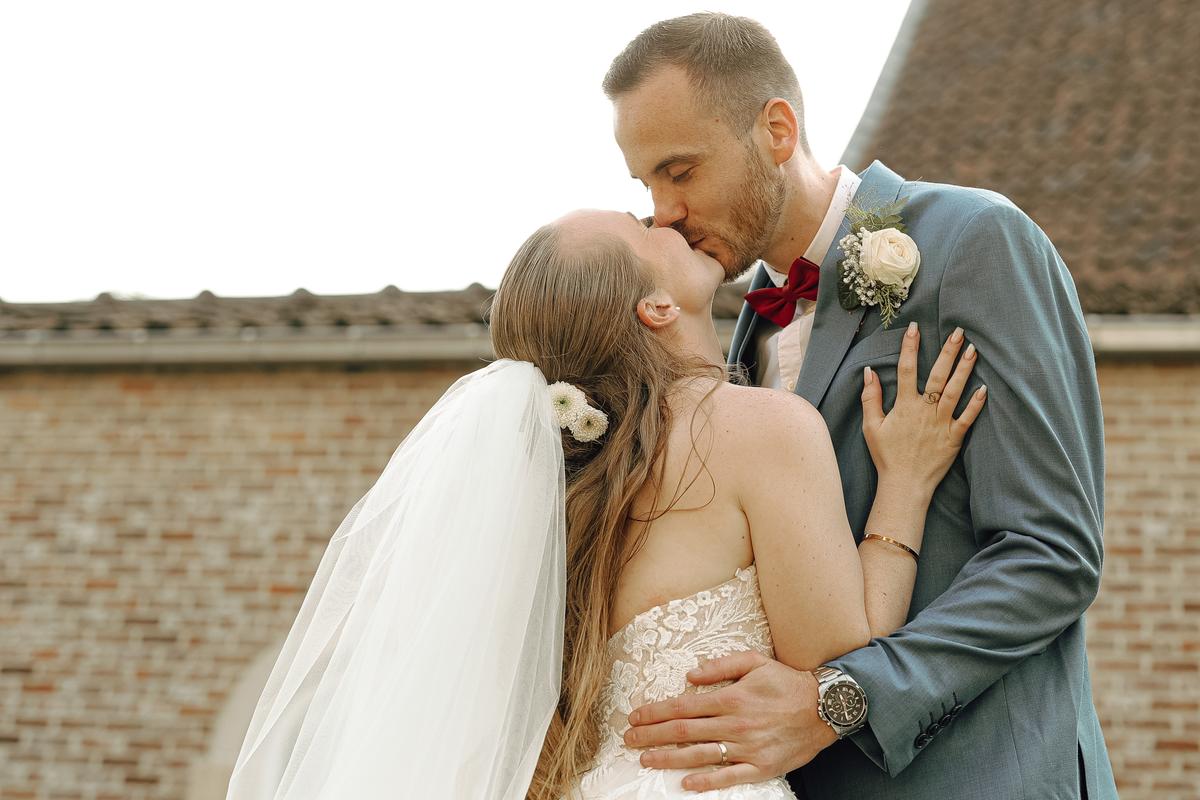 RAFAEL DUARTE PHOTOGRAPHE
Organise everything in one place
Whether you opt for legal cohabitation or a wedding, the preparation is similar: administrative procedures, budget, guests, suppliers. Centralise everything in your WeWED couple's space, with an interactive checklist and email reminders for each deadline.
Open my couple's space →And you, legal cohabitation as a first step, or a direct wedding for maximum protection? What influenced your choice? 👇
Frequently asked questions about legal cohabitation or a wedding
Legal cohabitation or a wedding: what's the real difference?
Both recognise you as a couple and provide almost identical tax treatment. The big difference is inheritance-related: the surviving spouse is a reserved heir and, without a will, inherits at least the usufruct of the entire estate, whereas the legal cohabitant can be deprived of their rights by a simple will.
Does legal cohabitation offer the same tax advantages as a wedding?
Essentially, yes. Legal cohabitants make a joint tax declaration like married couples and benefit from the "spouse" rate for inheritance tax, which is much more advantageous than that applied between unrelated individuals.
How to become legal cohabitants in Belgium?
Simply present yourselves together at the local council of your shared domicile and submit a written declaration to the registrar. The cost is low, sometimes nil, and there are no witnesses, no waiting period, and no ceremony.
Is a legal cohabitant entitled to a survivor's pension?
No. The survivor's pension is, in principle, reserved for married individuals. A surviving legal cohabitant is not entitled to it, even after many years of living together. This is one of the protections specific to a wedding.
How to end legal cohabitation?
Either by a joint declaration at the local council, or unilaterally: one partner takes the step, subject to a local council fee, which varies from one council to another, and bailiff's fees to notify the other. No legal proceedings, unlike divorce.
Do you need a notary to choose between legal cohabitation and a wedding?
It's not mandatory to declare legal cohabitation or to get married under the legal regime. But as soon as there are children, property, or assets to transfer, a visit to a notary allows you to adjust your marriage contract, will, or donation to your actual situation.
This article is based on public information from the Federation of Belgian Notaries (notaire.be), particularly its factsheets on legal cohabitation, inheritance between cohabitants, and the comparison between wedding / legal or de facto cohabitation. Inheritance tax rules fall under the Regions and may change; the amounts and exemptions cited are indicative. This content is for informational purposes only and does not constitute legal advice: for a binding decision, consult a notary.