Religious Wedding in Belgium: procedures, ceremony, and civil wedding articulation

Article summary
In Belgium, religious weddings have no legal value, and the civil wedding must always come first. Procedures at the church, ceremony déroulement, and special cases.
Summarise with AI
Many Belgian couples arrive at the church with a misconception: that the priest will marry them. They won't. Not in the legal sense, anyway. In Belgium, the civil registrar of your local council remains the only person capable of transforming two single people into a married couple in the eyes of the law. The priest, on the other hand, blesses a union that already exists on paper.
This nuance changes everything in the planning. It imposes an order (civil first, then religious), a often tight schedule between the two, and a series of parish procedures that no one really explains to you before you pick up the phone. This guide puts things in order: the legal framework, the faiths concerned, the concrete steps in the Catholic Church, the running of a ceremony, and problematic cases (mixed couples, remarriage, dispensations).
When you type "religious wedding Belgium" into a search engine, you mostly find local council sheets or isolated parish pages. It's difficult to get an overview. We've tried to provide one here, with an assumed bias: to be useful to the couples we see in Wallonia and Brussels, not to recite the catechism.
Under Belgian law, a religious wedding has no civil value. It is the civil wedding at the local council that creates rights and duties between spouses. The religious ceremony is a personal and spiritual choice that is added to the civil one, never replaces it.
Civil first: what Belgian law requires

Article 21 of the Constitution is unambiguous: "the civil wedding must always precede the nuptial blessing". In other words, no ceremony at the church, synagogue, temple or mosque until you have appeared before the civil registrar. This rule applies to all faiths, without exception.
And it's not just a theoretical principle. The Penal Code even provides for a fine (from 50 to 500 euros) for any minister of religion who blesses a union before the civil wedding, unless one of the engaged couple is in mortal danger. In practice, the penalty is rarely imposed, but no serious Belgian priest would take the risk. Concretely, you go to the local council first, then to the church.
The timing between the two is up to you. Some do everything on the same day (local council in the morning, church in the afternoon), others spread it over a few days or several weeks. Honestly, the "all on the same day" formula remains the simplest: one outfit, one celebration, one guest logistics. For the documents to be submitted to the town hall, we have detailed each item in our guide on the civil wedding documents to be submitted to the local council in Belgium.
To give you an idea of scale: StatBel recorded 48,589 weddings in Belgium in 2024. All of these are civil weddings, by definition. Religious weddings are not counted anywhere in these statistics, as they are grafted onto the civil wedding without their own legal existence.
Catholic, Orthodox, Protestant: recognised faiths

Belgium officially recognises six faiths: Catholic, Protestant-Evangelical, Orthodox, Jewish, Anglican and Islamic. In addition, there is organised secularism, also funded by the State under Article 181 of the Constitution. The SPF Justice pays the ministers of these faiths and secular delegates: this means more than 3,300 people employed by the federal state in 2025.
For a wedding, what does this change? Recognition does not dictate your rites, it primarily structures the funding and status of ministers. In terms of ceremony, Catholic remains by far the most popular in Wallonia and Brussels, but each faith has its own prerequisites: an Orthodox, Jewish, Protestant or Muslim wedding follows its own liturgy and conditions. The only absolute constant is the civil-first rule, which applies everywhere.
And if no denomination speaks to you, there is a third, increasingly popular option: the humanist ceremony, which also has no legal value, but is entirely customisable. We have dedicated a complete guide to how to organise a real humanist ceremony. The rest of this article focuses on Catholic weddings, which account for most of the questions we receive.
At the church: the first steps
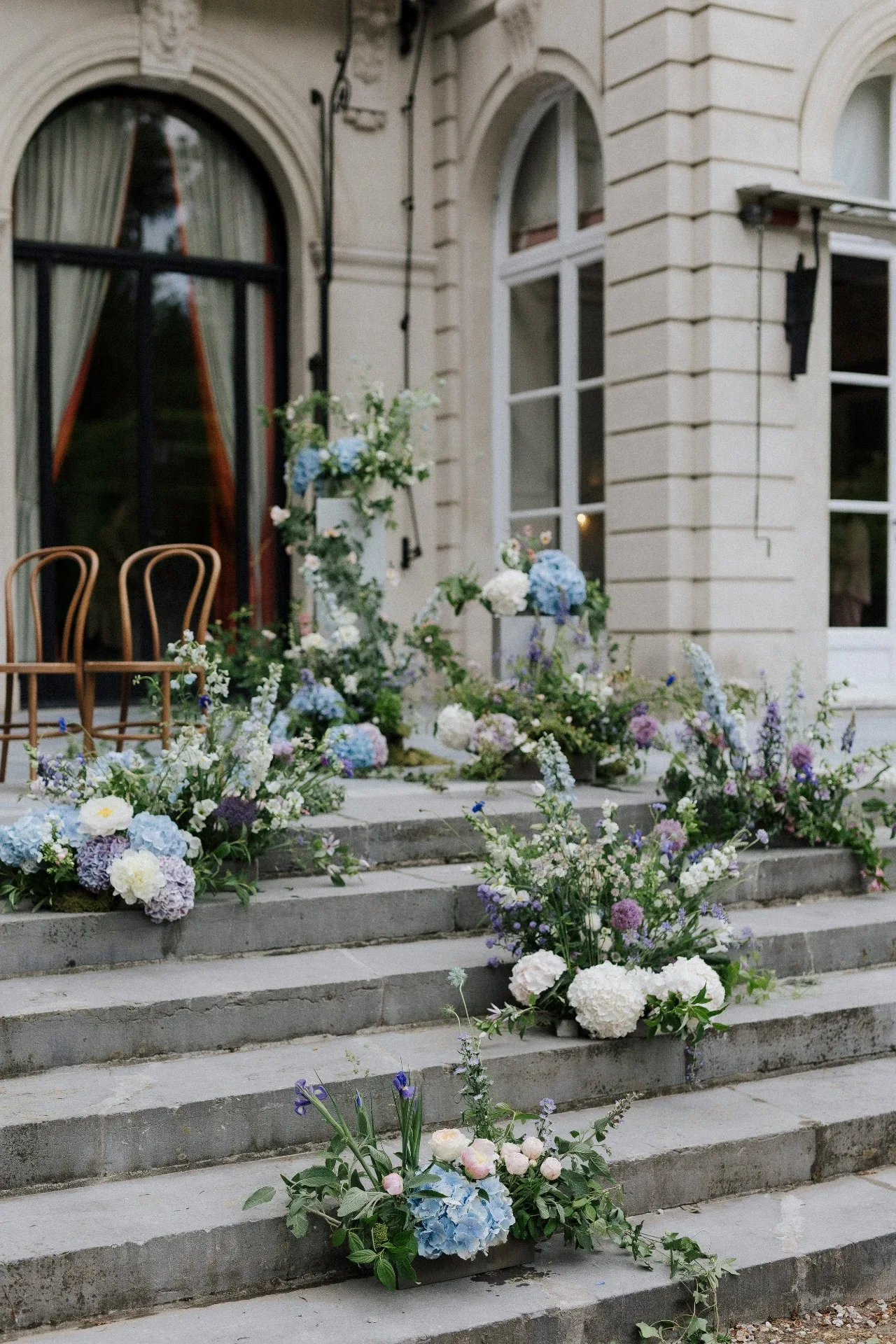 HARRIET DE FYNEMERE
The first reflex is not to book a florist or choose readings. It is to contact the parish where you live, and ask to speak to the priest or deacon. Ideally six to twelve months before the date. Active parishes are overwhelmed with requests in spring and summer, and some only accept a limited number of weddings per weekend.
During this first contact, the priest of one of the two engaged partners opens a wedding file, which includes an administrative and a pastoral section. You will be asked for a recent baptism certificate (often less than six months old), to be requested from the parish where you were baptised, sometimes at the other end of the country or abroad. Allow for the delay. In principle, at least one of the spouses is a baptised Catholic.
It is also at this time that you will be given the schedule of preparation meetings. Nothing insurmountable, but it needs to fit into an already busy schedule. If you want to see how this all fits together with everything else (the local council, the venue, the suppliers), our month-by-month planning for getting married in Belgium provides the complete timeline.
Religious procedures, in order
- 12 to 9 months before: first contact with the parish, checking date availability.
- 9 to 6 months before: opening of the wedding file, request for baptism certificate.
- 6 to 2 months before: preparation course (sessions or weekend), choice of texts and songs.
- 1 month before: final meeting with the officiant, optional rehearsal.
Wedding preparation, Belgian style

In Belgium, Catholic wedding preparation takes place either in your parish (this is called parochial preparation), or in a Marriage Preparation Centre (CPM), which brings together several parishes. The format varies from one diocese to another: a few evenings spread out, or an intensive session over a weekend, most often in the company of other engaged couples and a married couple who act as mentors.
The stated aim of the Church is not to test you. It is to foster dialogue within the couple on subjects that are sometimes avoided: money, children, each person's role, faith. Many couples arrive reluctantly, convinced they are wasting an evening. Many leave saying it was one of the few times they talked about something other than the seating plan. Honestly, it's worth going with an open mind.
Still, it adds another layer of organisation on top of the civil wedding, the venue, and the suppliers. This is exactly the kind of overlap where a guiding hand saves you.
Two weddings to organise, one brain
Civil, religious, preparation, suppliers: everything overlaps. On WEWED, you turn these steps into an interactive checklist and receive automatic email reminders for each deadline, so you don't forget the baptism certificate three weeks before the big day.
Organise our steps →The course of a Catholic ceremony
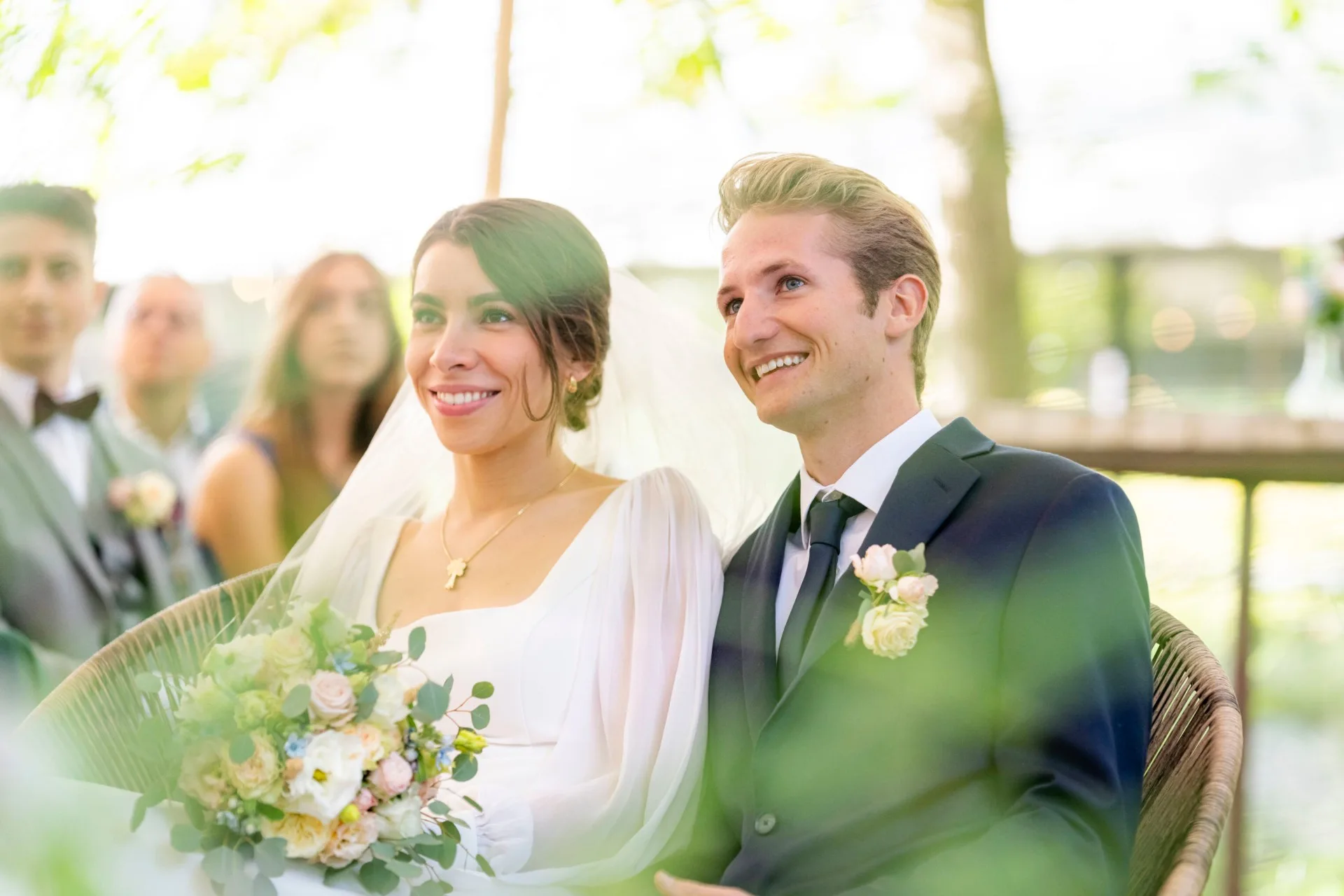 QPICS
QPICS
A Catholic wedding ceremony follows a stable framework, whether celebrated with or without Mass. Knowing its highlights helps you personalise them intelligently, and understand why your photographer may not have access to everything.
The reception and the Liturgy of the Word
- The reception: the officiant receives the married couple at the entrance, often followed by the entrance into the church in procession.
- The Liturgy of the Word: one or two biblical readings that you choose, a psalm, then the Gospel (to be selected from a given list) and the priest's homily.
The consent and the wedding rings
- The exchange of consent: the heart of the celebration, the moment when you receive each other.
- The blessing of the wedding rings: the officiant blesses them, you place them on each other's ring finger.
The nuptial blessing and the exit
- The nuptial blessing: if the ceremony includes a Mass, it is given just after the Our Father, during the Eucharistic liturgy.
- The universal prayer, the signing of the parochial registers (which have nothing civil about them) then the exit to applause.
Allow about 45 minutes for a ceremony without Mass, and rather 1 hour 15 to 1 hour 30 with Eucharist. Regarding images, many churches prohibit flash and ask for discretion during the liturgy. A photographer accustomed to reportage, such as QPICS near Nivelles, anticipates moments rather than creating them: they position themselves, they wait, they don't disturb the officiant. This is precisely what distinguishes good wedding reportage from simply a good photographer, a point we explore in our article on the cost of a wedding photographer in Belgium.
Flowers, readings, and music: personalising without distorting
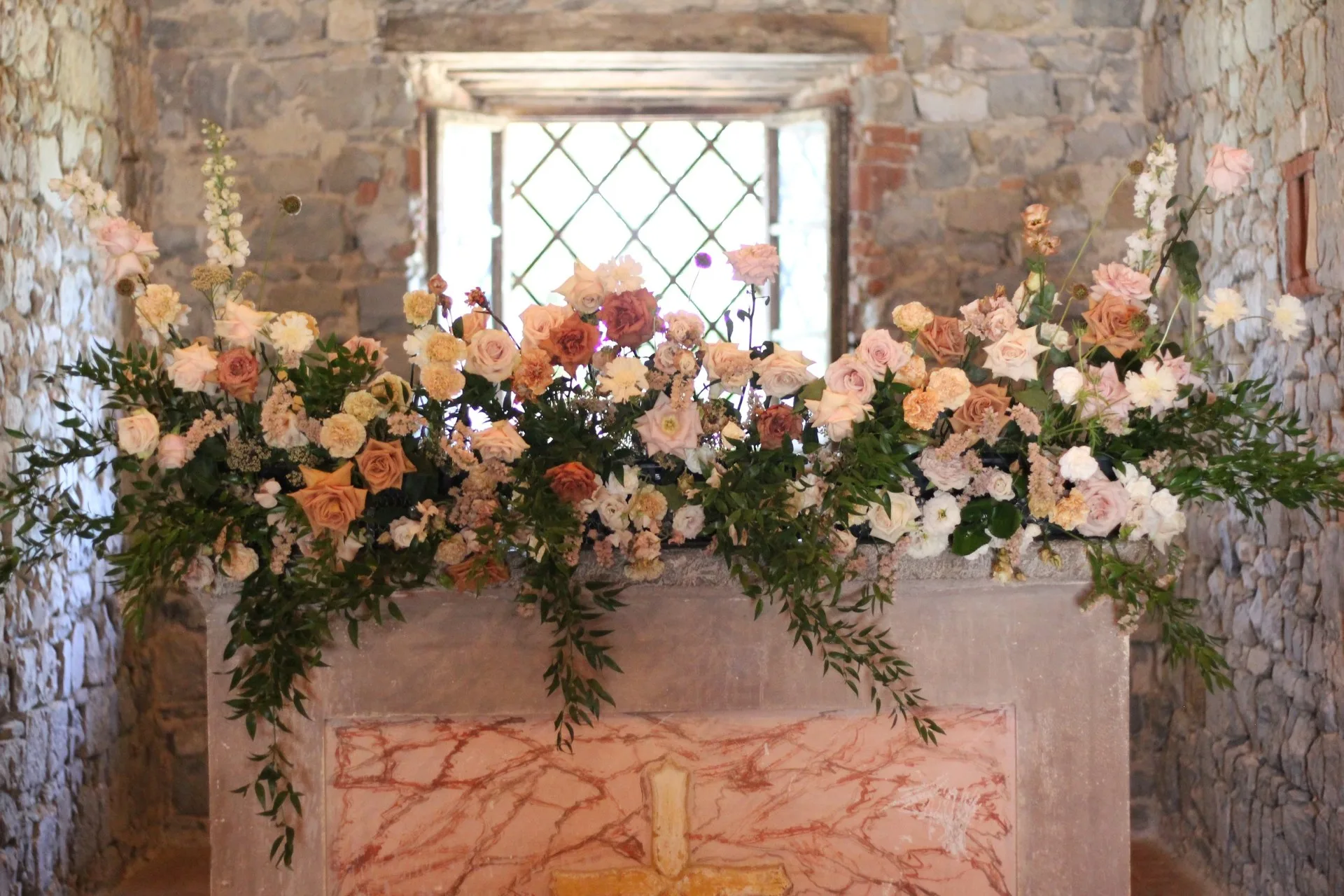 HARRIET DE FYNEMERE
This is where your ceremony truly becomes yours. First, the readings: you choose the first (sometimes a second) from the Old or New Testament, the psalm, and the Gospel from a selection. Then, the music, which greatly influences the atmosphere: organ, parish choir, sometimes a soloist or an instrument you bring. All of this is coordinated with the organist and the celebrant, who have their say on what is possible within the liturgical framework.
Flowers deserve a thorough discussion with the parish. Some churches restrict decoration, while others share arrangements when several weddings follow one another on the same weekend (a detail that can halve the bill). And decorating a church is not like decorating a reception venue: you have to compose for enormous volumes, particular lighting, and imposed anchor points. A florist accustomed to this exercise, such as Harriet de Fynemere in Brussels, knows how to play with height and sobriety rather than overwhelm the nave. For budget tips and key questions to ask, see our guide wedding florist in Belgium. And to compare profiles, the directory of Belgian suppliers is a great starting point.
After the blessing: the celebration
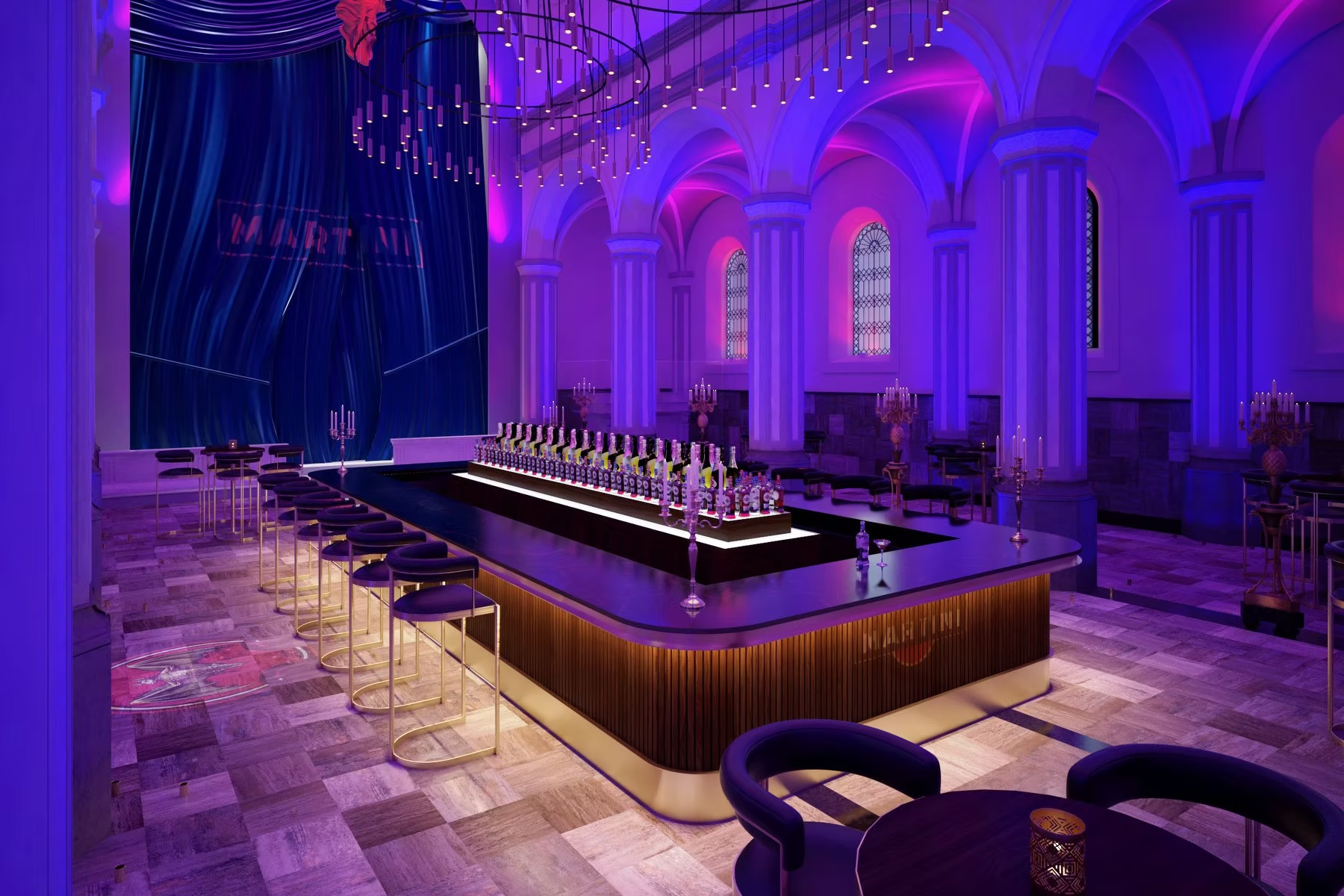 NAOS EVENT (ABBAYE D’AULNE)
The church does not offer a reception: upon leaving, you move on to another venue. And there is a real coherence to seek between the solemnity of the ceremony and the place where you will celebrate. Many couples who value religious commitment then turn to historic venues, which extend the emotion without mimicking it.
A striking example: NAOS Event, located in the former deconsecrated abbey church of Aulne Abbey, near Thuin. The vaulted volume is breathtaking. It is no longer a place of worship; it has become a reception space, but the heritage links to the spirit of the day. And once the venue is settled, your day-of timeline, hour by hour, can be shared with all suppliers, from the sacristan to the DJ.
Mixed couples, remarriage, dispensations
Not all profiles fit the mould. Three cases come up frequently, and it is best to anticipate them from the first meeting with the priest.
Mixed wedding. When a Catholic marries a Christian of another denomination (Protestant, Orthodox, Anglican), or an unbaptised person (this is called disparity of cult), the ceremony remains possible but requires authorisation or a dispensation granted by the bishop, via your parish. This must be requested; it cannot be improvised the day before.
Remarriage after divorce. This is the most delicate point. The Catholic Church does not recognise civil divorce: in its eyes, a first religious wedding remains valid. Remarrying in church therefore requires obtaining a declaration of nullity of the first religious marriage beforehand, a procedure conducted before an ecclesiastical tribunal, which can take time. If one of you is divorced, discuss it early and frankly with the celebrant.
Articulation with legal aspects. Religious matters do not regulate your assets: this is done by the civil wedding and, if applicable, your marriage contract. If you are hesitating between community property and separation of property, you need to see a notary, not a priest. The two processes are simply unrelated.
Religious wedding in Belgium: what you need to know
Have you planned to do everything on the same day, or to space out the civil and religious ceremonies by a few weeks? Tell us about your organisation, it helps couples who are still undecided. 👇
Frequently Asked Questions about religious weddings in Belgium
Can you have a religious wedding without a civil wedding in Belgium?
No. Article 21 of the Constitution requires that a civil wedding must always precede the nuptial blessing. A minister of religion who performs a ceremony before the couple has attended the local council risks a fine (except in cases of imminent death). This applies to all faiths.
Does a religious wedding have legal value in Belgium?
None. Only a civil wedding creates rights and duties between spouses. A religious ceremony is a personal and spiritual commitment that complements the civil wedding, with no legal effect of its own.
How far in advance should you contact the parish?
Ideally, 6 to 12 months before the date. Parishes often limit the number of weddings per weekend in spring and summer, and the paperwork (baptism certificate, preparation) takes time to complete.
Do you have to be baptised to get married in a Catholic church?
In principle, at least one of the fiancés must be a baptised Catholic. If the other is unbaptised or of another faith, the wedding is still possible with a dispensation or authorisation from the bishop, to be requested via the parish.
Can you get married in church again after a divorce?
Not directly. The Church does not recognise civil divorce: you must first obtain a declaration of nullity of the first religious wedding, via an ecclesiastical tribunal. The process can be lengthy, so discuss it with the priest early on.
How long does a Catholic wedding ceremony last?
Allow approximately 45 minutes without a Mass and 1 hour 15 minutes to 1 hour 30 minutes with a Mass (Eucharistic liturgy). The service includes the welcome, the Liturgy of the Word, the exchange of vows, the blessing of the wedding rings, and then the nuptial blessing.
This article is based on official Belgian sources: the Constitution (article 21) and the Penal Code (article 267) for the precedence of civil wedding; the Federal Public Service Justice for recognised faiths and their funding; CathoBel and the diocesan services for couples and family pastoral care (Walloon Brabant, Mechelen-Brussels) for procedures and preparation; belgium.be for civil formalities; StatBel for wedding figures (48,589 in 2024). Parish timings and customs vary from one diocese and parish to another: always check with your own. This article is for informational purposes only and does not replace the guidance of a priest or a civil registrar.


