Civil Wedding in Belgium: Documents Required by the Local Council, Step by Step

Article summary
An exhaustive list of documents to provide to the local council for a civil wedding in Belgium: legal timing, cases for Belgians, foreigners, legalisation and apostille.
Summarise with AI
The wedding file at the local council is rarely the first thing you imagine when you think about getting married. Yet, it is the only step without which nothing else can follow: no humanist ceremony, no reception, no signing in the grounds of a castle. Until the local council has accepted your file, your wedding has no official date.
And that's where it gets complicated. Each Belgian local council applies the Civil Code in its own way. Liège does not ask for exactly the same documents as Watermael-Boitsfort, which does not ask for the same thing as a village in Hainaut. If you were both born in Belgium and registered in the national register, you can complete the file in two weeks. If one of you was born abroad, it will take closer to three months.
Here is the actual list, the legal deadlines set by articles 63 to 64 of the Civil Code, the pitfalls that vary from one local council to another, and the order in which to tackle the procedures if you want to get married in 2026 without postponing your date.
This guide is based on the Belgian Civil Code (articles 63 to 165 on wedding), the official portal belgium.be, the FPS Justice and the civil status pages of several Walloon and Brussels local councils. It does not replace a visit to your local council's civil status department: the latest updated list is always available there.
Why the local council file deserves your attention sooner rather than later
Most couples we see arrive at the civil status department two quarters late. The reflex is to think, "we'll deal with the civil wedding at the end." It's the opposite. The civil wedding unlocks the date, and the date unlocks the wedding venue, the caterer, and everything else.
An urban local council like Brussels or Liège can have slots booked six to nine months in advance for Saturdays in May, June, and September. Waiting to have the wedding venue before calling the local council means running the risk that the alderman no longer has any Saturdays available within your supplier's window.

The order we recommend to couples is: call the local council as soon as you have an approximate date, ask which Saturdays are still available in the target window, book a slot, and only then start visiting wedding venues. For the complete timeline, we have detailed this in our monthly wedding planning guide.
The legal timing: between 6 months and 14 days before the date
The Belgian Civil Code sets two strict deadlines. You can submit your wedding declaration at the earliest 6 months and 14 days before the ceremony date, and at the latest 14 days before. Within this period, you are within the legal window. Outside of it, the local council cannot officiate your wedding.
The 14-day period is uncompressible: it is the old "publication of banns" period which was abolished in 2000 and replaced by this formal declaration. The local council must have time to register, verify, and publish your project (in practice, this means displaying it in the town hall entrance).
Deadlines to memorise
Many local councils recommend 5 weeks prior in their regulations, and this is honestly a better guideline. It gives them time to request a missing document without having to postpone your wedding.
The basic list for two Belgians born in Belgium
This is the simplest scenario. If both of you were born in Belgium and are registered in the national register, the civil registrar will retrieve the essential information directly from the national register. You no longer need to separately provide your birth certificate, proof of nationality, proof of residence or certificate of celibacy.

Specifically, at the town hall, you are almost systematically asked for:
- Your valid identity card (both spouses)
- Proof of the address of the ceremony if you are getting married in a different local council from your place of residence (rare, but possible if the local council agrees)
- A copy of the birth certificate if the local council cannot retrieve it via the national register (in the case of old or not yet digitised certificates)
- The identity, date of birth and address of your witnesses (1 to 4 adult witnesses in total, per couple)
When it comes to cost, don't expect everything to be free. There is no national rate: each municipality sets its own fees. Submitting the file is free in only 4 of the 28 municipalities that publish a fee for it; elsewhere it costs from 15 to 100 euros, or it is included in the ceremony fee. The ceremony itself is free on some days in 31 of the 49 municipalities we surveyed, often on a specific weekday or time slot. A Saturday ceremony, on the other hand, comes with a fee almost everywhere: for the cheapest slot, the median price is 150 euros, rising to 333 euros in Ghent, and afternoons often cost more. You'll find every fee in our survey of civil wedding fees, municipality by municipality.
If you (or your spouse) were born abroad
This is the case that requires the most anticipation. Almost everything the local council automatically retrieves for a Belgian registered in the national register, you must bring yourself, legalised, translated, and less than 6 months old for most documents.

Typical list for a foreign national getting married in Belgium:
- Full birth certificate (not just an extract), issued by the country of origin, legalised or apostilled depending on the country
- Certificate of celibacy or capacity to marry (often called a "no impediment certificate" or "certificat de coutume" depending on the country)
- Proof of nationality (passport copy or consular certificate)
- Proof of residence in Belgium or habitual residence of more than 3 months
- If divorced: copy of the previous marriage certificate and the divorce decree, legalised
- If widowed: death certificate of the previous spouse, legalised
- Certified translation into French, Dutch, or German for any document not written in one of these three languages
In my opinion, this is the situation where you should make an appointment with the civil registry office in advance, without a complete file, just to confirm the exact list required by that particular local council. A morning lost at the local council is well worth six lost chasing a refused apostille.
Legalisation, apostille, certified translation: the mechanics
Three words that constantly reappear and cause confusion. Here are the short definitions.
An apostille is an administrative endorsement added by the authorities of the country of origin, which is sufficient to make your document valid in Belgium. This applies to all countries that are signatories to the Hague Convention of 5 October 1961: the United States, United Kingdom, Turkey, Morocco, Tunisia, Russia, Ukraine, and a hundred others. A single procedure in the country of origin, and it's done.
Traditional legalisation applies to non-signatory countries of The Hague Convention: two steps, the Ministry of Foreign Affairs of the country of origin, then the Belgian consular post. Allow 4 to 12 weeks depending on the country.
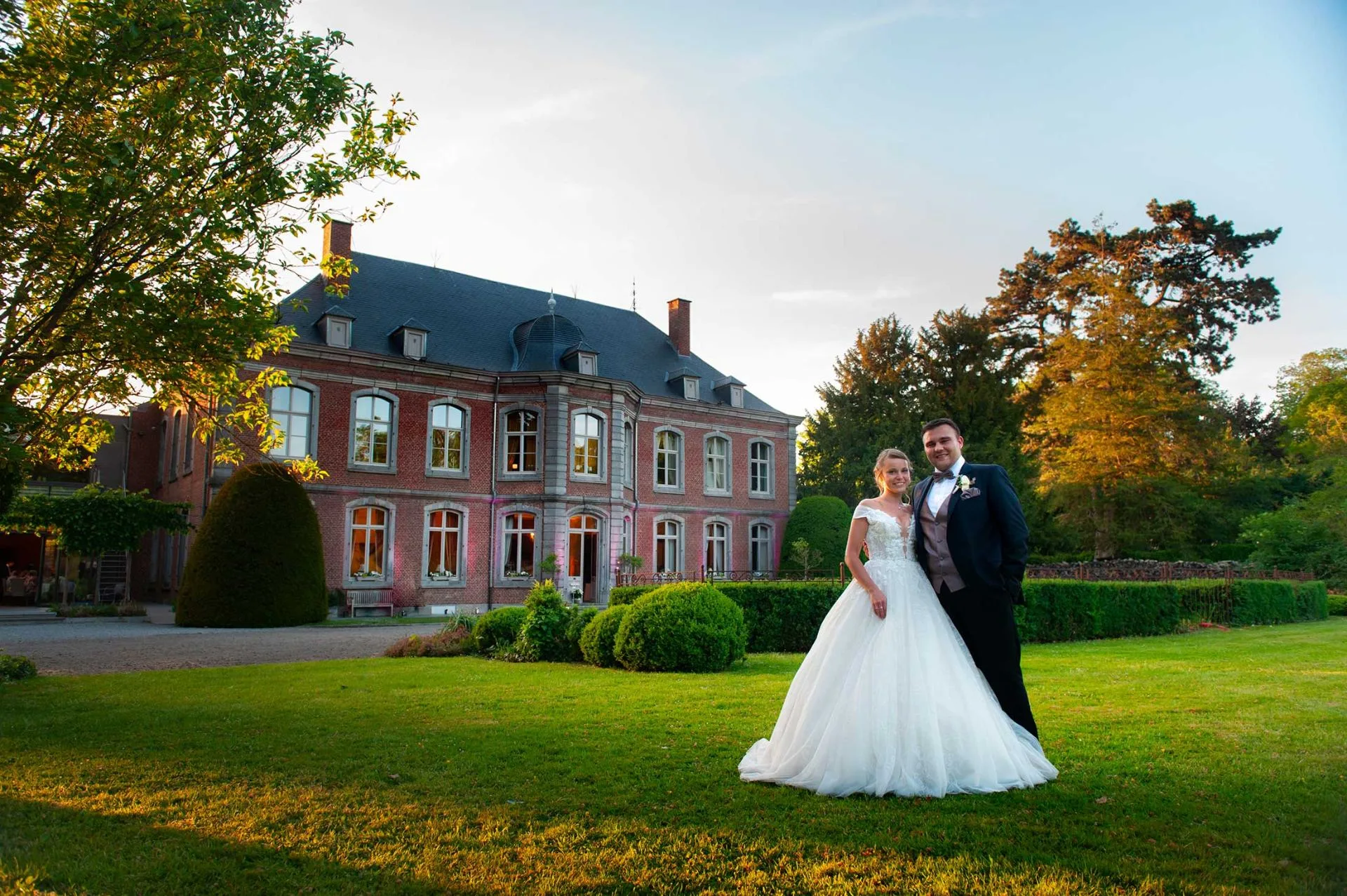 CHÂTEAU DE WANFERCÉE
A certified translation is the complementary step. Any document not written in French, Dutch, or German must be translated by a certified translator registered in the national register of sworn translators and interpreters (consultable online on the SPF Justice website). The original document and its translation are legalised separately. Indicative cost: 30 to 60 euros per translated page, and 20 euros for legalisation.
A small but genuinely useful detail: get it apostilled before having it translated. The translation covers both the document and its apostille, so doing it the other way around will force you to start over.
Special cases: divorced, widowed, common child, non-EU national
Some common situations that require an additional document, without necessarily complicating the application process.
You are divorced in Belgium: nothing to provide. The divorce is recorded in the national register, so the local council can see it. If the divorce was granted abroad, the judgment must be officially recognised (transcribed into the Belgian register), which can take several months. Entrust your local council or a notary with the procedure.
You are widowed: death certificate of the previous spouse, legalised if foreign. There is no waiting period between the death and remarriage under Belgian law.
You have a recognised common child: there is no legal obligation to provide anything for the wedding. However, many couples take advantage of the declaration to update their household composition, so it's a good opportunity.
You are a non-EU national on a short stay: be aware of suspicions of sham marriages. The local council may forward your application to the public prosecutor's office for a thorough investigation. This can add 2 to 3 months to the process. This is not a refusal, but a verification, though it will automatically postpone the possible wedding date.
To anticipate all these variations, we advise keeping a centralised file with copies, scanned originals, and validity periods for each document. This is exactly what the interactive WEWED checklist was designed for.
The appointment at the local council and the acknowledgement of receipt
On the day of submitting the application, it rarely takes more than twenty minutes. The registrar checks each document, has you sign the declaration of wedding, and gives you an acknowledgement of receipt. Keep this document carefully: it proves that the 14-day period has begun.

The local council officially posts your wedding project in the hall (formerly "publication of the banns") for a minimum of 14 days. If anyone wishes to object, this is the window of opportunity. In practice, objections are extremely rare in Belgium, except in cases of document fraud or reported sham marriages.
Take advantage of this appointment to finalise the last details of the big day: number of witnesses, order of signatures, possible presence of a photographer in the wedding hall, duration of the slot (most Belgian local councils reserve 20 to 30 minutes per couple on Saturday mornings).
If you are planning a humanist ceremony afterwards, this is a good time to confirm the schedule with your officiant. Belgian officiants like Ludwina from Mysa Events generally advise allowing a good buffer period between leaving the local council and arriving at the humanist ceremony venue.
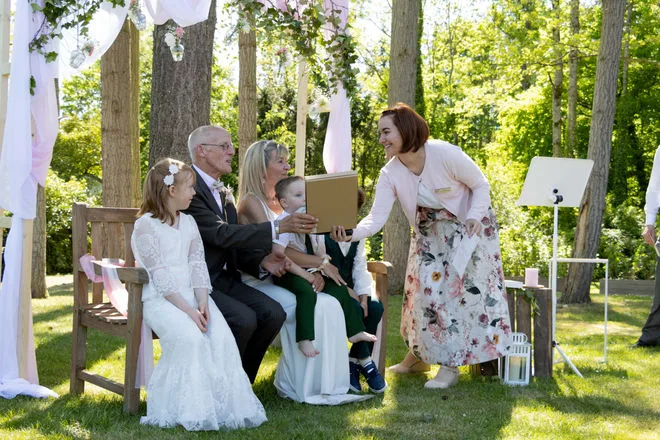 MYSA EVENTS
The civil wedding day: what the local council does, what it doesn't do
The registrar reads articles 212 to 213 of the Civil Code on the rights and duties of spouses, asks for your consent, has you sign the register, and gives you the marriage booklet. That's it. It's quick, factual, and honestly not very customisable.
The alderman officiating may deliver a short speech, sometimes personalised if you provide them with some information about yourselves beforehand. But don't count on the local council to carry the emotion of your day. For that, the humanist ceremony takes over, immediately after or later in the day. To properly calibrate the timing between the civil wedding, humanist ceremony, drinks reception, and reception, we have gathered all the benchmarks in our article on the photographer and their role in the chronology of the big day.
A few small things that surprise couples:
- You don't choose your alderman. Unless explicitly requested and accepted, it's the elected official on duty that day.
- The number of guests in the room is limited (varies by local council, often 30 to 80 people maximum).
- Rice, petals, confetti are prohibited in most town halls (sometimes allowed outside on the forecourt).
- The marriage booklet is given to you at the end. It is often charged separately: from 15 to 83.50 euros depending on the municipality (a median of 30 euros), based on the 36 municipalities surveyed that publish its price.
Centralise your entire wedding journey in one place
Local council documents, deadlines, suppliers, and big day schedule: the interactive WEWED checklist brings together everything that needs to be done before and after the visit to the local council, with automatic email reminders at key deadlines.
Start my WEWED space →Once the civil application is complete, two steps take over: finding the right venue and finalising the timeline. For venues, our selection of castles for weddings in Wallonia provides a good starting point, and the cost breakdown by item for 2025-2026 helps frame decisions. For smaller formats, see the guide on intimate weddings for 30 guests.
You can also browse the directory of Belgian suppliers, or finalise your big day schedule hour by hour.
And what about you, did your local council ask for an unexpected document on the list? We're interested in your feedback. 👇
Frequently Asked Questions about civil wedding documents in Belgium
What are the minimum documents required for a civil wedding in Belgium?
For two Belgians born and registered in the national register, it's an identity card and the identity of the witnesses. The local council retrieves the rest (birth certificate, proof of single status, nationality, residence) directly from the national register. For a foreign national, a full birth certificate, proof of single status, proof of nationality and residence must be added, all legalised or apostilled and translated if necessary.
How long before the wedding should the documents be submitted to the local council?
The Belgian Civil Code sets a strict window: at the earliest 6 months and 14 days before the date, at the latest 14 days before. Most local councils, however, recommend a minimum of 5 weeks beforehand, to allow time to request any missing documents without postponing the date.
How much does a civil wedding cost in Belgium?
It depends on the municipality and the day: you'll find every fee in our survey of civil wedding fees, municipality by municipality. In 31 of the 49 municipalities surveyed, the ceremony is free on some days, often on a specific weekday or time slot. A Saturday ceremony comes with a fee almost everywhere: for the cheapest slot, a median of 150 euros and up to 333 euros in Ghent, and some municipalities charge more in the afternoon. The marriage booklet costs from 15 to 83.50 euros (a median of 30 euros). For a couple with foreign documents, also factor in 20 euros per legalisation, approximately 30 to 60 euros per page of certified translation, and the apostille fees from the country of origin.
Can you get married in a local council other than your home local council?
Yes, it's possible but not automatic. You must apply to the local council where you are domiciled (which remains responsible for the declaration), and obtain the agreement of the local council where you wish to hold the ceremony. Some very popular Belgian local councils (Brussels, Liège, central Namur) limit access to their halls to residents.
What is the difference between apostille and legalisation?
The apostille is a simplified procedure provided for by the 1961 Hague Convention: a single administrative endorsement in the country of origin is sufficient. Classic legalisation is the procedure for non-signatory countries: it requires two steps (authority of the country of origin then Belgian consular post). The cost is 20 euros per document in both cases, but legalisation can take 4 to 12 weeks.
How many witnesses are required for a Belgian civil wedding?
The Belgian Civil Code has not imposed any minimum number of witnesses for the civil ceremony since the 2014 reform. You can get married without witnesses, or have 1, 2, 3 or 4 (maximum 4 in total for the couple). Witnesses must be adults and present a valid identity document. Their identity is recorded in the wedding certificate.
Article based on the Belgian Civil Code (articles 63 to 165 on wedding), the official portal belgium.be, wedding formalities, the FPS Justice (legalisation of documents), the FPS Foreign Affairs (apostille and legalisation) and the civil status pages of the local councils of Liège, Brussels, Tournai and Watermael-Boitsfort. The indicated deadlines and costs are estimates observed in April 2026, to be confirmed with your local council.


