Changing your name after wedding in Belgium: what really changes (and what doesn't)

Article summary
In Belgium, a wedding doesn't change your surname. Customary name, identity card, passport, children's names, mixed-nationality couples: the clear and sourced guide.
Summarise with AI
In films, the bride signs "Mrs. So-and-so" the day after the wedding. Then you get married in Belgium, and no one at the local council asks you what name you want to use. That's normal: the question doesn't arise.
Name change after wedding does not exist in Belgian law. You keep the name from your birth certificate, your spouse keeps theirs, and the wedding certificate changes nothing. What you can do is use the other's name in everyday life. What you cannot do is have it appear on your identity card.
This article describes the Belgian framework for Belgians domiciled in Belgium. If one of you has another nationality, the law of that nationality may sometimes apply: consult your local council's civil registry.
What Belgian law says: your name does not change

In Belgium, your name is fixed at birth and only changes through a dedicated procedure, of which marriage is not a part. The SPF Foreign Affairs states it clearly: marriage has no impact on the spouses' names, and does not imply that the woman takes the man's name, unlike in many other countries.
The wedding certificate therefore mentions both spouses by their birth name. Identity card, tax authorities, mutual insurance company: everything continues with the name you have always had. Nothing to sign, nothing to pay. The name change after wedding, in the French or American sense, has no equivalent here.
And frankly, that's good news: no cards to redo, no bank paperwork. This point applies to everyone, women, men, same-sex couples, and regardless of your matrimonial regime. Marriage contract or not, the name issue is independent.
The customary name: what is tolerated in daily life
 LV PHOTOGRAPHE
Nothing prevents you from presenting yourself under your spouse's name. Signing "Marie Dupont-Janssens", engraving "Janssens family" on the doorbell: this is the customary name, tolerated in everyday life as long as the marriage lasts.
But tolerated does not mean recognised. As soon as a document involves something (contract, notarised deed, credit file), it is the name on your identity card that must appear there. Full stop.
The classic pitfall: booking the honeymoon flight in the spouse's name. The passport says something else, the airline refuses boarding. Tickets, accounts, insurance: only the name on your identity documents.
Identity card, passport, bank: who accepts what
Spouse's name, document by document
The mention on page 4 of the passport is not a name change: it is a note indicating that you are the husband or wife of a certain person, particularly useful for Belgians living in countries where the marital name is the norm. As for banks, accepting the wording "Mrs. Janssens" depends on internal policy: the account will in any case be under the official name.
Your children's name: the real choice to make

The only real decision related to the name is made at the birth of the first child. Since the 2014 reform, parents are free to choose: the father's name, the mother's name, or both combined in the order they wish (articles 335 and 335ter of the old Civil Code).
Two rules to know. The choice made for the first child applies to all siblings. And in case of disagreement, the child receives the double name in alphabetical order (law of 25 December 2016, after the Constitutional Court annulled the rule that automatically gave the father's name).
In my opinion, this is what should be discussed by both of you before the wedding, much more than the customary name. A child named "Dupont Janssens" will only be able to pass on one of their two names.
The transmission of a name does not depend on wedding. A couple in legal or de facto cohabitation who recognise the child have exactly the same options.
Officially changing your name: the procedure
Some couples wish to bear the same legal name. This is possible, but it follows the general procedure, not through wedding: there is no simplified or expedited post-wedding name change.
The request is made to the SPF Justice, based on the law of 15 May 1987 relating to names and first names. A name change is not a right but a favour granted by royal decree, for serious reasons. Being married is not one in itself. A registration fee is due (around EUR 140 at the time of writing, to be checked on justice.belgium.be), and deadlines are counted in months, often more than a year.
Honestly, if your only motivation is to bear your spouse's name: keep your legal name, use the customary name, and choose a common name for the children.
Mixed couples and Belgians abroad: the nuance

According to StatBel, about a quarter of the weddings celebrated in Belgium in 2024 involved a partner of another nationality. For these couples, the rule has exceptions: the name is governed by the law of nationality, not by that of the country where the wedding takes place.
A foreign spouse may have their name modified by their own national law. And since 1 January 2018, a Belgian domiciled abroad at the time of wedding can, under certain conditions, have the marital name acquired there recognised in Belgium. In all cases, only Belgium decides on your name under Belgian law: contact your local council's civil registry before the wedding, with your documents in hand. This also applies to a destination wedding from Belgium.
Wedding invitations, mail, social media: managing without complicating your life
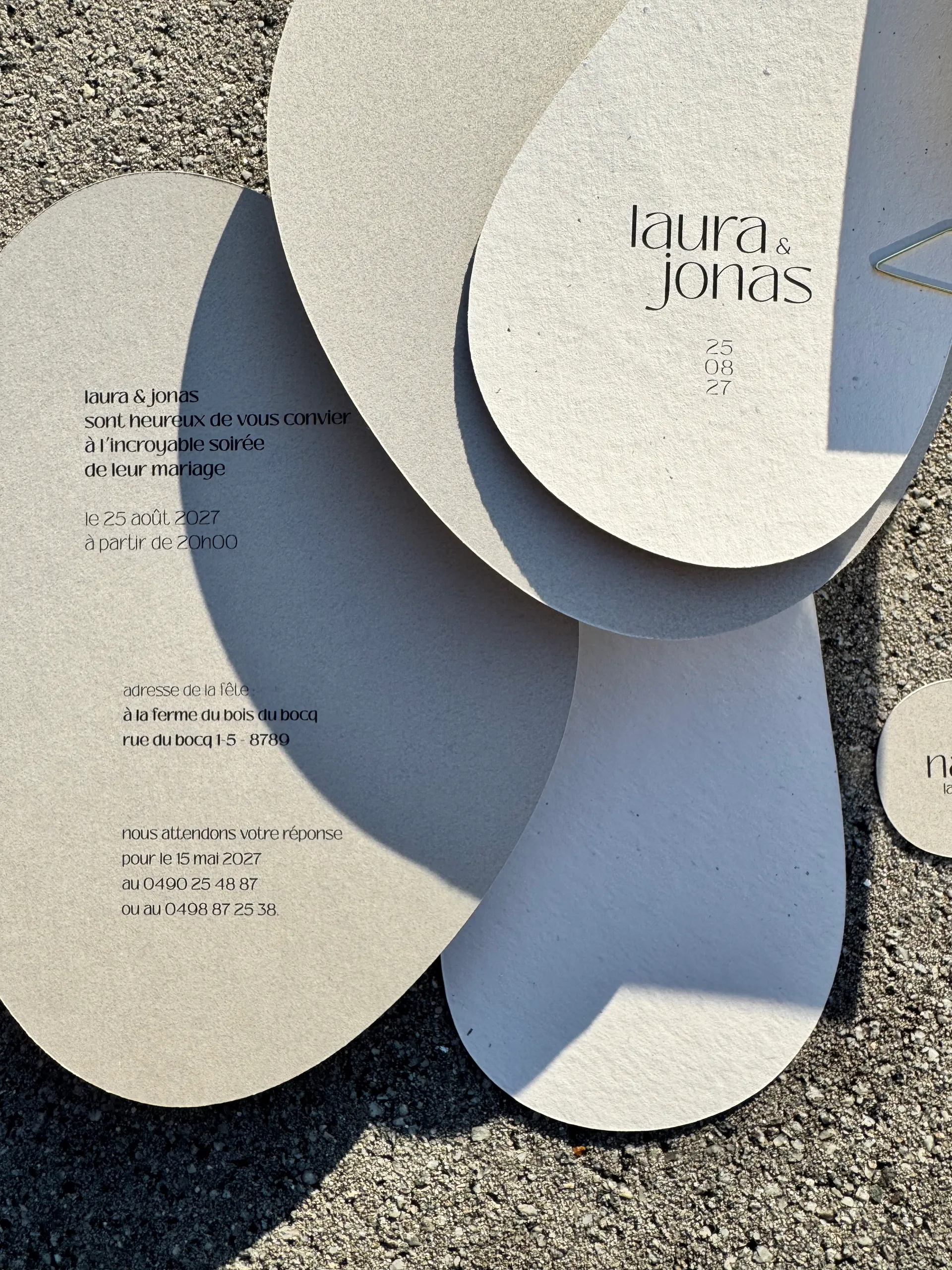 AIMANT
For the wedding invitation, the common Belgian formula remains "Marie and Thomas", first names only. Walloon stationery workshops like Aimant in Ciney see fewer and fewer "Mr and Mrs Janssens" on cards.
For mail, put both names on the letterbox and keep your legal name visible, otherwise a registered letter may never reach you. If you change your professional name, notify your HR: your payslip will remain under the name on your eID.

The civil wedding is paperwork before it's a party
Documents to gather, deadlines to meet, then the real preparations: centralise everything in one space, with an interactive checklist and email reminders for each deadline.
Open my couple's space →The name is the only point of your wedding where Belgian law asks you to do nothing. Take advantage of it, and put this time into the civil wedding paperwork or into the twelve-month timeline leading up to the big day.
And you, are you each keeping your own name, adopting a common customary name, or have you already decided for the children? 👇
Frequently Asked Questions about names after wedding in Belgium
Does the wife take her husband's name in Belgium?
No. In Belgium, a wedding has no impact on the surname. Each spouse keeps the name from their birth certificate on all official documents, including the wedding certificate and identity card.
What is the 'usage name' after wedding?
This refers to using one's spouse's name in everyday life, for example, on a doorbell or in an email signature. It is tolerated, but it has no legal value: contracts, flight tickets, and official documents always bear your official name.
Can the spouse's name appear on a Belgian identity card?
No, this is not possible on the eID. On a Belgian passport, the spouse's name can be entered on page 4 upon request. This is not a change of name, only a mention.
What is the official procedure for changing a surname in Belgium?
An application to the FPS Justice, based on the law of 15 May 1987. A name change is a favour granted by royal decree for serious reasons, with a registration fee and long processing times. Wedding alone is not a sufficient reason.
What surname do children of a married couple receive?
Parents choose the father's name, the mother's name, or both hyphenated in the order of their choice. This choice applies to all siblings. In case of disagreement, the child receives the double name in alphabetical order.
What happens if my spouse has a different nationality?
The name follows the law of each person's nationality. A foreign spouse can therefore change their name according to their own law. A Belgian domiciled abroad can also, under certain conditions, have a marital name acquired there recognised. Enquire with your local council before the wedding.
Sources: FPS Foreign Affairs (filiation and name in Belgian law), FPS Justice (changing name, attribution of surname), belgium.be, Institute for the Equality of Women and Men and StatBel (weddings 2024). Observations on usage are based on our market interpretation. This is not legal advice.