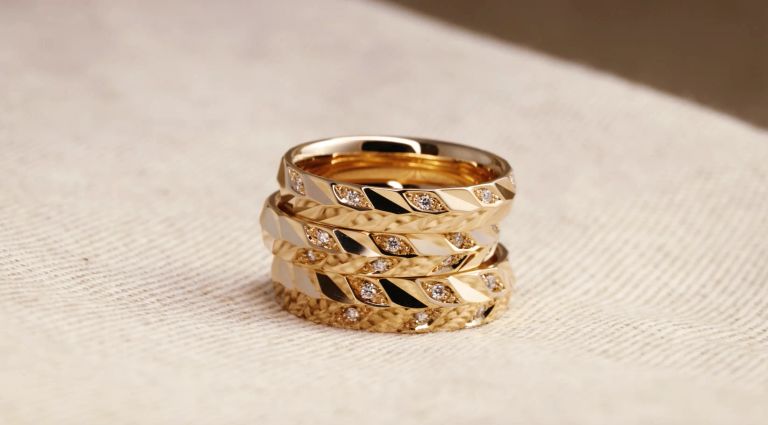
Engagement Rings in Belgium: 2026 Prices, Natural or Lab Diamond, Where to Buy (Antwerp, Brussels, Liège)

Article summary
2026 engagement ring prices in Belgium, the 4Cs without the jargon, natural or lab-grown diamonds, moissanite, where to buy in Antwerp, Brussels or Liège, and legal requirements.
Summarise with AI
Choosing an engagement ring in Belgium means buying an item you will wear every day for decades, often without knowing anything about gemstones, and under pressure that dates back to an old advertising campaign. Not a great combination.
The good news is that you live an hour away from Antwerp, the historic diamond hub, and the market has changed profoundly over the last three or four years. Lab-grown diamonds have driven prices down, moissanite and coloured gemstones have earned their stripes, and Belgian law has required a written document for every diamond purchase since 2023.
This guide cuts through the noise: the 4Cs without the jargon, natural or lab-grown, real 2026 prices, where to buy between Antwerp, Brussels and Liège, and the practical details people always forget.
The prices mentioned in this article are rough guides observed among Belgian jewellers in early 2026. The price of gold and the diamond market fluctuate quickly: always ask for a dated quote.
The "three months' salary" rule: forget it
There is nothing traditional about this rule. It is an advertising slogan from the diamond company De Beers, which initially suggested one month's salary, then two, then three across successive campaigns. It was a marketing target, not an established custom.
Frankly, the only sensible budget is one that does not jeopardise the rest of your plans. If you are also planning a wedding or buying a home, the ring needs to fit into the bigger picture. The couples we meet most often spend between €1,000 and €3,500, and many opt for less, with absolutely no regrets.
The 4Cs explained simply

The price of a diamond depends on four criteria, known as the 4Cs.
- Carat (weight): 1 carat = 0.2 grams. Prices jump at certain thresholds: 0.95 ct costs significantly less than 1.00 ct, with no visible difference.
- Colour: from D (colourless) to Z (yellow tint). At G or H, the eye perceives virtually nothing once the stone is set.
- Clarity: internal inclusions. An "eye-clean" VS2 or SI1 clarity is more than enough.
- Cut: this is what gives the stone its sparkle. The one criterion on which you should never compromise.
Our advice: spend your money on the cut, go down a grade in colour and clarity, and aim for a carat weight just below a round number. You often save 20 to 30% on the bill without any visible difference.
Natural or lab-grown diamonds

A lab-grown diamond is a real diamond: identical carbon, identical hardness, identical brilliance, simply created in a few weeks. Only specialised equipment can tell them apart.
What sets them apart is the price, which has collapsed. The Antwerp World Diamond Centre (AWDC), the body representing the Antwerp diamond industry, cited an example in March 2026 of a natural diamond priced at 8,900 dollars whose synthetic counterpart cost around 100 dollars. Bear in mind that the AWDC champions natural diamonds, but the gap is very real, and the jewellers we speak to confirm it.
- You want a large stone on a tight budget: lab-grown is unbeatable. A full carat becomes genuinely accessible.
- You care about rarity and heirloom value: natural still makes sense. Lab-grown diamonds, on the other hand, have virtually no resale value.
In our view, the real mistake would be paying natural diamond prices for a lab-grown stone. It happens, which is why the mandatory document we discuss below is so important.
Moissanite and coloured gemstones
 GOLSONG JEWELLERY
Moissanite is a distinct gemstone from diamond, very hard, with even more fire (some people even find it "too" brilliant). It costs a fraction of the price and holds up exceptionally well to daily wear. Its only drawback is how it is perceived.
Coloured gemstones represent the real underlying shift. Sapphire is the sturdiest option for daily wear, whereas emerald is more fragile. Pink morganite and tourmaline appeal to couples looking to move away from classic white stones.
Brussels jewellers like Golsong Jewellery, who work with ethical stones alongside gemmological guidance, are seeing more and more couples arrive with a colour in mind rather than a carat weight.
Yellow gold, white gold, platinum
In Belgium, the standard remains 18-carat gold (75% pure gold). A small catch: white gold is often rhodium-plated, and this plating wears away. Expect a visit to the jeweller every one to two years.
Platinum is naturally white, denser and more durable, but significantly more expensive to buy. And the price of gold, very high since 2024, has pushed up the cost of all settings.
Consider how it will pair with the wedding ring that follows. We explore this in detail in our guide to wedding rings in Belgium: a heavily curved or halo ring will not sit neatly beside just any wedding ring.
2026 prices: the real ranges
Observed price ranges (early 2026, 18ct gold)
These amounts include Belgian VAT (21%) and a classic setting. A halo, pavé setting or platinum quickly adds a few hundred euros. Bespoke is not necessarily more expensive than a major luxury brand: you do not pay for the advertising.
And if you are already planning ahead, include this item in your overall wedding budget. It comes out of the same savings.
A single place for your entire budget
Centralise your budget, guests and suppliers in one place. Record the engagement ring, wedding rings and each expense as you go, with a breakdown by category.
Open my couple space →Where to buy: Antwerp, Brussels, Liège

Antwerp is an obvious draw. The diamond district, around the Central Station, is home to hundreds of dealers. Prices for loose stones can be lower there, but many houses deal mainly with trade professionals, and the sales pressure in some street-level shops is real. Arrive with your criteria written down and your maximum budget in mind. The hub is holding firm: almost 20% higher trading volumes in the first quarter of 2026, according to the AWDC.
Brussels offers the widest choice: prestigious houses in the Sablon and along Avenue Louise, alongside discreet independent workshops operating by appointment only.
Liège and its surrounding region have a rich tradition of artisan jewellers, with workshops crafting pieces on site. It is often the best value for money for bespoke designs. To compare profiles, browse the directory of Belgian suppliers active on WEWED, or read our guide to finding your suppliers without spending every weekend on it.
 PL MARTIN
With an artisan in Namur like PL Martin, the process involves an appointment, a sketch or 3D render, sometimes a wax model, followed by manufacturing. Allow four to eight weeks.
What Belgian law guarantees you
Since 1 May 2023, a Royal Decree of 26 January 2023 requires diamond sellers to provide consumers with a written document prior to purchase. It must state:
- whether the piece contains natural or synthetic diamonds, and how many;
- whether the stones are treated or not, and the type of treatment;
- the diamond weight;
- the company's identity (company registration number, address), dated and signed.
Always request it. The AWDC itself acknowledges that the rule is not consistently applied, and it currently only covers in-person sales, not online shops. For a significant stone, also ask for a certificate from a recognised laboratory (HRD Antwerp, IGI or GIA). If in doubt, Antwerp offers an independent stone testing service, Checkpoint Diamond.
The Minister of the Economy is considering restricting the word "diamond" exclusively to natural stones, with others sold as "synthetic". No decision had been taken by spring 2026.
Ring size, engraving, insurance
 LE COMPTOIR ANVERSOIS
Finding the ring size in secret. The most reliable way: borrow a ring your partner wears on their ring finger (left or right hand depending on your customs), and have it measured. Alternatively, ask a trusted friend or relative. No need to panic: most artisans, such as Le Comptoir Anversois in Liège who also remodel heirloom jewellery, will resize the ring after the proposal. Unless it has a full eternity band set with stones all the way round.
Engraving. Initials, a date, or words meant only for the two of you. Often complimentary or charged at a few tens of euros. Keep it short.

Insurance. Your home insurance may cover jewellery, but often with a low limit and only inside the home. For a valuable piece, request a valuable items extension and keep the invoice and certificate together.
Once the question has been popped, things move quickly: our month-by-month planning timeline helps you set out the main milestones without stress.
And what about you: natural diamond, lab-grown, or coloured gemstone? What tipped the scales? 👇
Frequently asked questions about engagement rings in Belgium
What is the average price of an engagement ring in Belgium?
From what we observe in early 2026, most couples spend between €1,000 and €3,500. A good quality, one-carat natural solitaire often exceeds €6,000, whilst an equivalent lab-grown diamond sits between €900 and €2,500.
Is a lab-grown diamond a real diamond?
Yes. It has the same composition and the same hardness as a natural diamond, and only specialised equipment can tell them apart. It costs considerably less, but its resale value is virtually non-existent.
Is it cheaper to buy an engagement ring in Antwerp?
Sometimes, especially for a loose stone. An independent jeweller in Brussels or Liège often offers a comparable price with more personal guidance.
What document must the jeweller provide in Belgium?
Since 1 May 2023, the seller must provide a written, dated, and signed document stating whether the diamonds are natural or synthetic, their quantity, their weight, and any potential treatments. For a significant stone, also request an HRD, IGI, or GIA certificate.
How can you find out someone's ring size without raising suspicions?
Discreetly borrow a ring already worn on the ring finger and have it measured by a jeweller, or enlist the help of a close friend or relative. Most artisans will resize it afterwards.
Should you insure your engagement ring?
For a valuable ring, yes. Home contents insurance often covers jewellery with a limited payout cap and only inside the home. Ask for a valuable possessions extension and retain both invoice and certificate.
Sources: Royal Decree of 26 January 2023 regarding pre-contractual information in diamond sales, presented by the AWDC (awdc.be); AWDC press release of 10 March 2026 on distinguishing natural from synthetic (awdc.be); Q1 2026 figures from the Antwerp diamond trade (awdc.be). Prices reflect broad estimates observed among Belgian jewellers in early 2026, not official rates.